
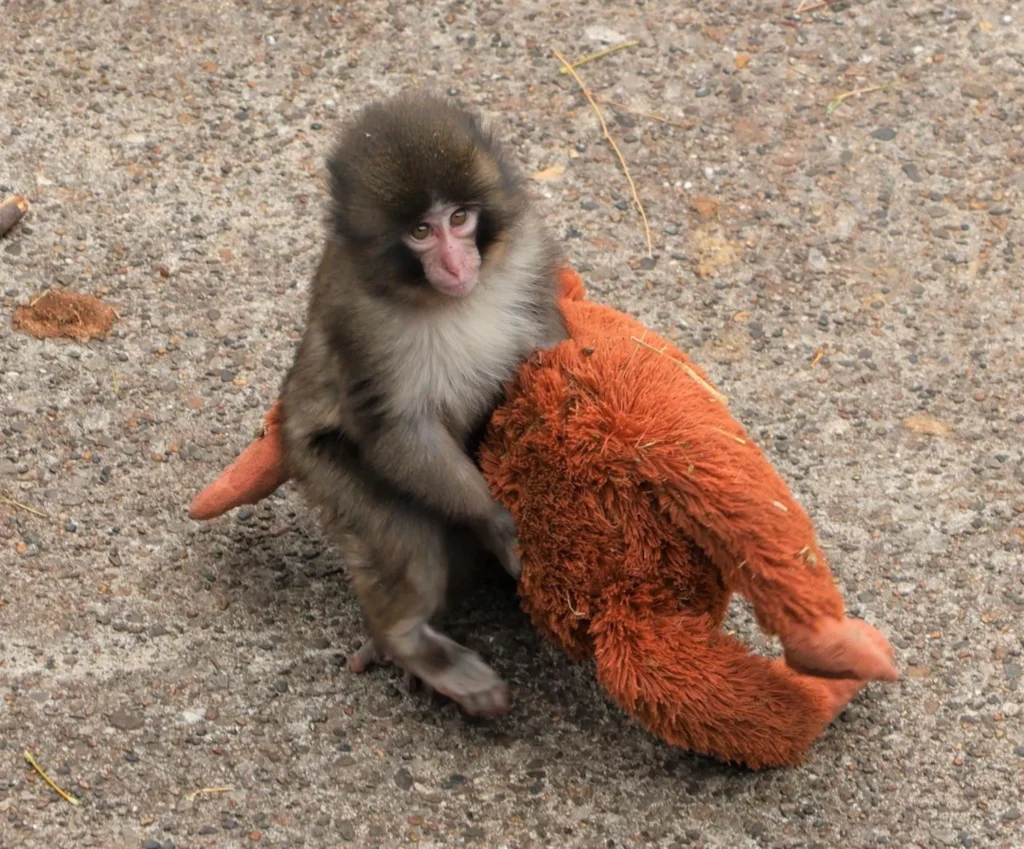
Ichikawa City, Chiba, Japan — In early February 2026, a tiny Japanese macaque named Punch — affectionately known as Panchi-kun — began appearing on social media screens around the world, unwittingly sparking one of the most heartwarming viral phenomena of the year. What started as a few poignant clips of a forlorn baby monkey clutching a stuffed toy soon exploded into an international sensation, resonating deeply with millions of people across cultures and continents.
Punch’s story is rooted in adversity. Born at the Ichikawa City Zoo and Botanical Gardens in Chiba Prefecture on July 25, 2025, he was rejected by his mother shortly after birth — a rare but not unheard-of occurrence among primates. Without maternal care, the young macaque was at risk of failing to learn essential social behaviors. Zookeepers intervened, hand-rearing him with round-the-clock attention.
But perhaps the most striking moment in his early life came when staff introduced a plush orangutan toy from IKEA (the DJUNGELSKOG model) into his enclosure. Designed to give the infant both comfort and something to cling to — much as macaque infants cling to their mothers — the toy quickly became Punch’s constant companion. Fans around the world soon dubbed it “Oran-Mama,” after witnessing how tightly the monkey held and dragged it everywhere he went.
The internet’s fascination with Punch began on February 5, 2026, when the Ichikawa City Zoo posted a video showing him with his beloved plushie. Within hours, the clip had racked up millions of views on TikTok, Instagram, X (formerly Twitter), and other platforms. The hashtag #がんばれパンチ — loosely translated as #HangInTherePunch — began trending not just in Japan but across the Americas, Europe, and Asia.
What made Punch so compelling was not just his “cuteness” — though that was undeniable — but the emotional narrative that unfolded in real time: loss, loneliness, perseverance, and the search for connection. Users across social platforms started sharing memes, fan art, emotional essays, and their own stories of resilience in alignment with Punch’s journey. Some compared the plush toy to a “security blanket” in childhood, while others used the monkey’s struggle as a metaphor for social anxiety, rejection, and resilience in human life.
In several countries, people began using Punch’s story to send messages about empathy and community. Notably, the Delhi Police in India shared Punch’s story on social media, turning it into a gentle campaign about compassion and support for those feeling isolated or alone — human or animal.
Meanwhile, the original toy that helped spark the movement saw an astonishing surge in demand. The IKEA DJUNGELSKOG orangutan plush quickly sold out in stores across Japan, the U.S., South Korea, and beyond, with some resellers listing rare units for prices as high as hundreds of dollars. In response, IKEA itself embraced the story — donating dozens of plush toys to the zoo and celebrating the symbolic “comfort companion” in its own global marketing channels.
On the ground at the Ichikawa City Zoo, the effects of Punch’s fame have been tangible. Visitor numbers have surged, prompting staff to manage crowds and regular zoo operations. Officials issued a public statement of “heartfelt gratitude” for the overwhelming interest, noting that the attention has helped raise broader awareness about primate welfare and the challenges animals face in captivity.
Beyond the influx of onlookers, Punch’s story has taken a hopeful turn. Recent viral footage shows an adult macaque, named Onsing, gently grooming and embracing Punch — a powerful sign of social acceptance in primate culture. This moment, in particular, captivated global audiences, who saw in it the possibility of healing and community integration after hardship.
Scientists and animal behaviorists have also weighed in, noting that Punch’s attachment to his plush toy mirrors foundational psychological research on comfort and attachment. Some experts caution that while the narrative is touching, humanizing animal behavior can sometimes mislead audiences about wildlife needs; others view the story as an opportunity to educate the public about animal social structures and welfare.
As the months go by and Punch grows into his role — both as a young macaque learning to navigate social dynamics and as a symbol of resilience for millions online — his story continues to evolve. For many, he is more than just a viral animal: he represents the universal desire to belong and the hope that kindness — whether from a fellow macaque, a human caregiver, or the shared compassion of strangers across the world — can make a difference.
source: ai generated




Leave a Reply
You must be logged in to post a comment.