
Artificial intelligence has become part of daily conversation, but the way most people talk about it is riddled with misconceptions. Some of these come from science fiction, some from marketing hype, and some from a simple lack of visibility into how these systems actually work. Here are the biggest things people get wrong.
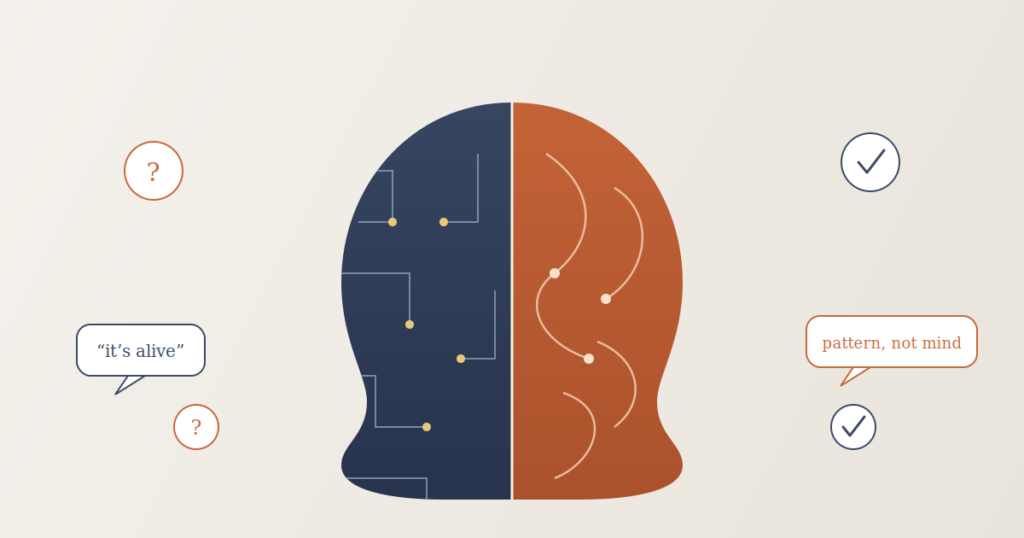
Large language models generate text by predicting likely sequences of words based on patterns learned from massive amounts of data. This can look a lot like understanding, especially when the output is fluent and confident. But there’s an important difference between producing correct-sounding text and possessing genuine comprehension, intent, or awareness. The model has no persistent inner life, no beliefs it’s checking against, and no sense of “meaning” the way a person does. It’s closer to an extremely sophisticated pattern-completion engine than a mind.
People often treat AI output as binary: either it’s a genius that got the answer right, or it’s “hallucinating” nonsense. In reality, most AI mistakes are subtler than that. A model might get 90% of a complex answer right and quietly slip in one wrong date, misattributed quote, or invented detail. This is precisely what makes AI dangerous to use uncritically — the errors are often camouflaged by confident, well-formatted prose rather than announced.
A lot of people assume AI is retrieving facts from some giant database, like a smarter Google. But most language models generate answers from patterns learned during training, not by looking things up in real time (unless the tool explicitly has web search or retrieval built in). This means:
Model size (parameter count) matters, but it’s not the whole story. Training data quality, fine-tuning, architecture choices, and how a model is prompted can matter just as much, sometimes more, than raw scale. A smaller, well-trained model focused on a narrow task can outperform a massive general-purpose one. The “bigger is always better” narrative oversimplifies a much more nuanced engineering tradeoff.
Because AI output often has a neutral, matter-of-fact tone, people assume it’s free of bias. In reality, models learn from human-generated data, which carries all the biases, blind spots, and cultural assumptions of the people and text that produced it. Bias can show up in subtle ways — who gets described favorably, what “default” assumptions get made, which perspectives are underrepresented — and it takes deliberate effort to identify and mitigate it.
This is one of the most persistent misconceptions, fueled heavily by pop culture. Current AI systems, however impressive, are not conscious, don’t have subjective experiences, and don’t “want” anything in the way a sentient being does. They simulate conversational and reasoning patterns extremely well, which can create a compelling illusion of inner experience. But an illusion of empathy or self-awareness isn’t the same as the real thing — and the two are very easy to conflate when the output feels emotionally resonant.
The public conversation often jumps straight to “AI will take my job,” without addressing the more immediate reality: AI is primarily changing how tasks within jobs are done, automating specific sub-tasks (drafting, summarizing, coding boilerplate) rather than eliminating entire roles overnight. The bigger near-term risk for most people isn’t total replacement — it’s needing to adapt to new tools and workflows, and competing with people who use AI more effectively.
Perhaps the most practically important misconception: people equate a model’s tone with its accuracy. AI models are trained to produce fluent, assertive-sounding text regardless of whether they’re certain about the underlying facts. There’s no built-in mechanism that makes uncertainty “sound” uncertain unless the model is specifically designed or prompted to hedge. This mismatch between confidence and correctness is one of the main reasons AI-generated misinformation spreads so easily.
When AI generates an image, a poem, or a block of code, it can feel like the tool conjured something out of thin air. In reality, everything it produces is a remix, in some statistical sense, of patterns extracted from the data it was trained on. This doesn’t mean AI output can’t be genuinely novel or useful — combinations of existing patterns can produce real creativity — but it’s not creation in a vacuum, and understanding that helps explain both its strengths (fluency, breadth) and its weaknesses (repetition of biases, occasional derivative output).
Maybe the most consequential misunderstanding is treating AI output as a finished product rather than a draft. The tools work best as a collaborator: fast at generating options, summarizing, and exploring ideas, but still dependent on a human to verify facts, catch errors, and apply judgment about context and stakes. Skipping that verification step is where AI’s real-world failures tend to cause the most damage — not because the technology is fundamentally broken, but because it’s being used as if it were something it isn’t.
Understanding these misconceptions doesn’t require distrusting AI wholesale — it requires calibrating expectations. These systems are powerful pattern-matching and language-generation tools, not oracles, not minds, and not neutral arbiters of truth. Used with that understanding, they’re remarkably useful. Used without it, they can quietly mislead.
by: admin




Leave a Reply
You must be logged in to post a comment.