
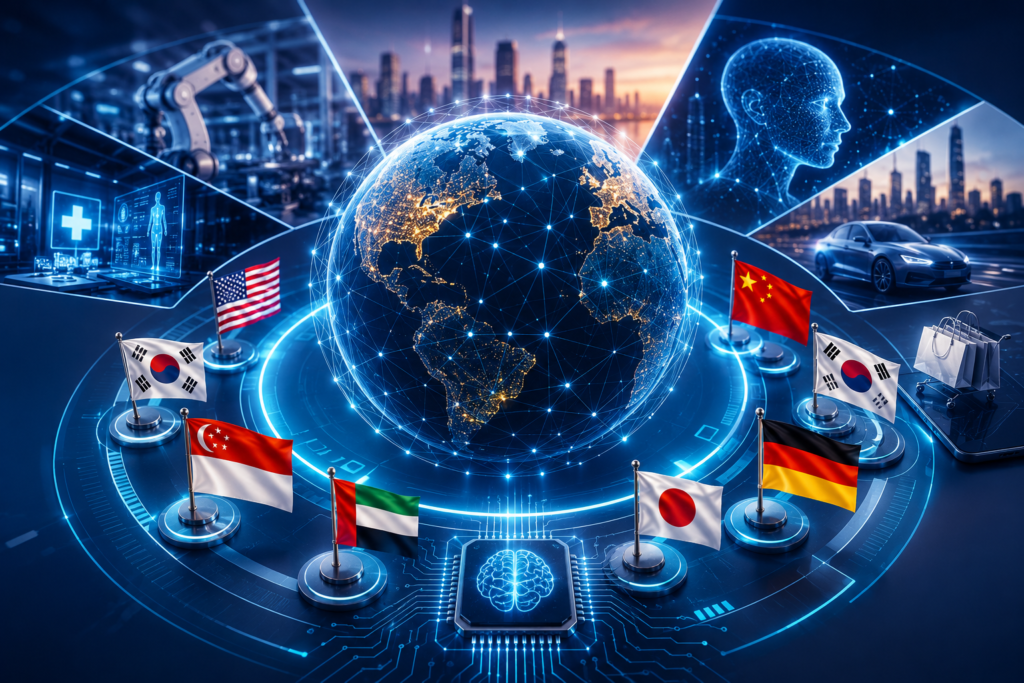
Artificial Intelligence (AI) is no longer a futuristic concept—it has become an essential part of everyday life for billions of people around the world. From personalized shopping recommendations and smart assistants to AI-powered healthcare, transportation, banking, and education, countries are rapidly integrating AI into daily activities. While AI adoption varies across regions, some nations have embraced the technology faster than others due to strong digital infrastructure, government support, and high consumer acceptance.
Here are the top 10 countries leading the world in everyday AI usage.
The United States remains the global leader in AI innovation and consumer adoption. Home to technology giants such as OpenAI, Google, Microsoft, Meta, Amazon, Apple, and NVIDIA, AI has become deeply embedded in everyday American life.
The U.S. also leads in AI research, startup funding, and enterprise adoption across nearly every industry.
China has integrated AI into almost every aspect of daily life. With strong government backing and advanced digital ecosystems, AI powers transportation, shopping, finance, healthcare, and public services.
Chinese consumers interact with AI multiple times a day without even realizing it.
South Korea is among the world’s most technologically advanced societies, making AI adoption exceptionally high.
The country’s widespread 5G coverage has accelerated AI integration into homes and businesses.
Singapore has positioned itself as one of the world’s smartest nations through government-led AI initiatives.
Nearly every government department uses AI to improve efficiency and citizen services.
The UAE has become one of the Middle East’s AI leaders. It was among the first countries to appoint a Minister of Artificial Intelligence and has ambitious plans to become a global AI hub.
Dubai’s vision of becoming the smartest city continues to accelerate AI adoption across public and private sectors.
Japan has long embraced robotics, making AI a natural extension of everyday life.
Japan’s aging population has significantly increased demand for AI-assisted healthcare and robotics.
The UK has rapidly adopted AI across financial services, education, healthcare, and retail.
London has become one of Europe’s largest AI startup ecosystems.
Germany combines industrial excellence with advanced AI adoption in manufacturing and everyday services.
German businesses increasingly rely on AI to improve productivity while consumers benefit from smarter digital services.
Canada is recognized as one of the birthplaces of modern AI research and continues to be a global leader.
Canadian universities continue producing world-class AI researchers, strengthening national innovation.
India has witnessed explosive AI adoption thanks to affordable smartphones, digital payments, and government digital initiatives.
With one of the world’s largest internet populations, India is expected to become one of the fastest-growing AI markets over the next decade.
Several common factors explain why these countries lead in AI usage:
Across these leading nations, AI has become common in:
Artificial Intelligence is expected to become even more integrated into daily routines over the next decade. Personal AI assistants, autonomous transportation, AI-powered healthcare, intelligent homes, and workplace automation will transform how people live and work. Countries investing in AI infrastructure, digital education, and innovation today are likely to lead the global economy tomorrow.
Rather than replacing humans entirely, AI is increasingly acting as a powerful assistant—helping people make better decisions, save time, and improve productivity. As adoption continues to grow, AI will become as fundamental to everyday life as smartphones and the internet are today.
The United States and China currently lead the world in AI adoption, followed closely by technologically advanced nations such as South Korea, Singapore, the United Arab Emirates, and Japan. Meanwhile, countries like India and Canada are rapidly expanding AI usage through digital transformation and innovation. As AI technology continues to evolve, its impact on everyday life will only become more significant, shaping the future of work, education, healthcare, and society on a global scale.
Web Admin




Leave a Reply
You must be logged in to post a comment.