
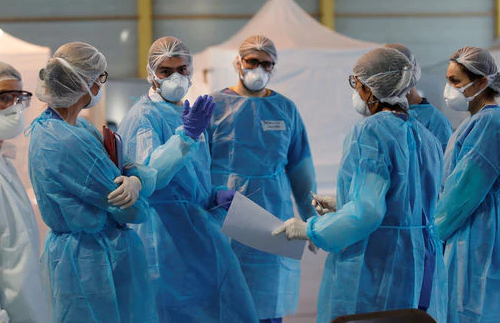
During these tough times, the people who bring a ray of hope to masses suffering from the dangerous pandemic are the doctors, nurses, paramedics, technicians, pharmacists and healthcare workers on the whole. Undoubtedly, this specific group of people is acting as a shield for us all against the deadly disease while putting their own lives at risk.
Unfortunately, hundreds of these unsung heroes all around the globe have lost their precious lives in last three to four months while treating Covid-19 patients. Losing healthcare workers to this epidemic is a great tragedy and it highlights the limitations in our systems which seem to fail in providing enough safety measures to them. At the moment, the limited supply of personal protective equipment including shortage of gloves, masks, gowns, head covers and eye goggles is a worldwide issue.
This shortage of resources has aggravated the situation for both care providers as well as the patients. Since this constraint of limited PPE does not seem to be solved on urgent basis, there are some personal safety guidelines which health practitioners are advised to adopt by Centers for Disease Control.
Firstly, it is utmost important to identify and separate patients with coughing or respiratory issues from rest of the patients while also informing and guiding them about wearing masks and adopt cough etiquettes. Hand sanitizers, tissues and trashcans should be made available to the incoming patients. In case a patient shows symptoms of coronavirus, they must be immediately transferred to the AIIR i.e. airborne infection isolation room.
Meanwhile, unguided use of PPE can also be dangerous since it can lead to self-contamination. Ideally, hospitals should guide their staff properly regarding correct use of PPE. In case of reusing the items of personal protection due to unavailability of new ones each time, health practitioners should make sure to clean those after encounter with each patient. Also, health care personnel should wear masks all the time during their shifts except when leaving the hospital. Only then, they may switch the facemask with a cloth based face covering.
The fabric based face covers can become highly risky if they get the saliva or respiratory secretions hence, extra care should be taken to remove these immediately if they become unclean. The most crucial way of avoiding self-contamination by face mask is to properly follow hand hygiene before and after using face covering.
Hand hygiene is also highly essential to maintain before and after the contact with a patient as well. If hands are clearly soiled, health practitioners should first wash hands with soap and water for a minimum of 20 seconds. After that, they should return to alcohol based hand rub. It is the duty of hospitals and medical facilities to ensure the availability of hand hygiene equipment.
The isolation gowns must be worn right before entering the patient’s area and it should be removed and placed in a specified container after leaving the care area. It is best to use disposable gown which could be discarded after use but as the supplies are short at present, these should be carefully laundered after each use. CDC has also provided additional strategies for optimized use of gowns.
The above mentioned advices are just a few out of several guidelines mentioned by CDC with the sole purpose of providing safe and secure environment for the health care workers who are undoubtedly the front line soldiers protecting us against this fatal and invisible enemy.
by: Noor Ul Ain
Tags: we are concerned for our Medical Soldiers



Leave a Reply
You must be logged in to post a comment.