
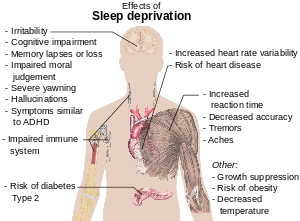
Sleep deprivation is the condition of not having enough sleep; it can be either chronic or acute. A chronic sleep-restricted state can cause fatigue, daytime sleepiness, clumsiness and weight loss or weight gain. It adversely affects the brain and cognitive function. Few studies have compared the effects of acute total sleep deprivation and chronic partial sleep restriction.
Randy Gardner holds the scientifically documented record for the longest period a human being has intentionally gone without sleep not using stimulants of any kind. In 1964 – as a 17-year-old high school student in San Diego, California – Gardner stayed awake for 264 hours (eleven days), breaking the previous record of 260 hours held by Tom Rounds of Honolulu.
Gardner’s record attempt was attended by Stanford sleep researcher Dr. William C. Dement. Gardner’s health was monitored by Lt. Cmdr. John J. Ross. Accounts of Gardner’s sleep-deprivation experience and medical response became widely known among the sleep research community.
However, Lt. Cmdr. John J. Ross, who monitored his health, reported serious cognitive and behavioral changes. These included moodiness, problems with concentration and short term memory, paranoia, and hallucinations. On the fourth day he had a delusion that he was Paul Lowe winning the Rose Bowl, and that a street sign was a person. On the eleventh day, when he was asked to subtract seven repeatedly, starting with 100, he stopped at 65. When asked why he had stopped, he replied that he had forgotten what he was doing. On his final day, Gardner presided over a press conference where he spoke without slurring or stumbling his words and in general appeared to be in excellent health. “I wanted to prove that bad things didn’t happen if you went without sleep,” said Gardner. “I thought, ‘I can break that record and I don’t think it would be a negative experience.'”
There are several different types of sleep deprivation from which a person can suffer and which range in severity.
On the more minor side of the scale we have acute and partial sleep deprivation in which the sleeplessness lasts for less than two days or where some sleep actually is achieved but there is less than our bodies need and so our “sleep debt” gets built up over time.
On the more extreme side of things there is Chronic and Extreme sleep deprivation. This is where the sleeplessness lasts longer than just a few hours or days and goes on for so long that a person might start to experience extreme physical symptoms in addition to the already present feelings of being tired.
REM Sleep Deprivation falls on the harsher side of the spectrum. REM (Rapid Eye Movement) deprivation is where the body sleeps but not ever deeply enough to achieve a proper REM cycle (which is considered by experts to be the most “productive” and important part of your overall sleep cycle).
It has been estimated that over 20% of adults suffer from some form of sleep deprivation. Insomnia and sleep deprivation are common symptoms of depression and can be an indication of other mental disorders. The consequences of not getting enough sleep could have dire results; not only to the health of the individual, but those around them as sleep deprivation increases the risk of human-error related accidents, especially with vigilance-based tasks involving technology.
Symptoms of moderate to severe sleep deprivation can include:
Suggestions on how to get more sleep include:
Annual sleep-related accidents in transportation alone claim over 5,000 lives, cause hundreds of thousands of injuries, and assess a cost in the billions in health care costs, death, lost productivity, and damage to propertySleep loss is cumulative. The sleep debt and chronic sleep deprivation are comouflaged by endogenuous and exogenous stimulation and circadian rhythm effects. Thus, an individual may not feel sleepy at one time of day, but may experience the sudden onset of completely disabling drowsiness when all stimulating influences are withdrawn (which explains many of our sleep-related accidents).
Napping can immediately reduce dangerous drowsiness.
Sleep deprivation statistics show that 40 percent of Americans (about 100 million) are sleep deprived.
References:
Sleep Deprivation, Psychosis and Mental Efficiency, Stanley Coren Ph.D., March 1998, Vol. XV, Issue 3
Eleven days awake, Extract from “Elephants on Acid: And Other Bizarre Experiments,” by Alex Boese.
Elephants on Acid: And Other Bizarre Experiments, Alex Boese, ISBN 0-15-603135-3, Harvest Books, 5 Nov 2007
Neurological Findings After Prolonged Sleep Deprivation, Ross J. (1965), Archives of Neurology 12:399-403.
Coren, Stanley (01 March 1998). “Sleep Deprivation, Psychosis and Mental Efficiency”. Psychiatric Times 15 (3). Retrieved 2009-11-25. Baruss, I. (2003). Alterations of Consciousness: An Empirical Analysis for Social Scientists.American Psychological Association.Feldman, R. S. (2007). Essentials of Understanding Psychology. McGraw-Hill Companies.
Tags: Gardner's record, REM (Rapid Eye Movement), REM Sleep, sleep, Sleep deprivation




Leave a Reply
You must be logged in to post a comment.