
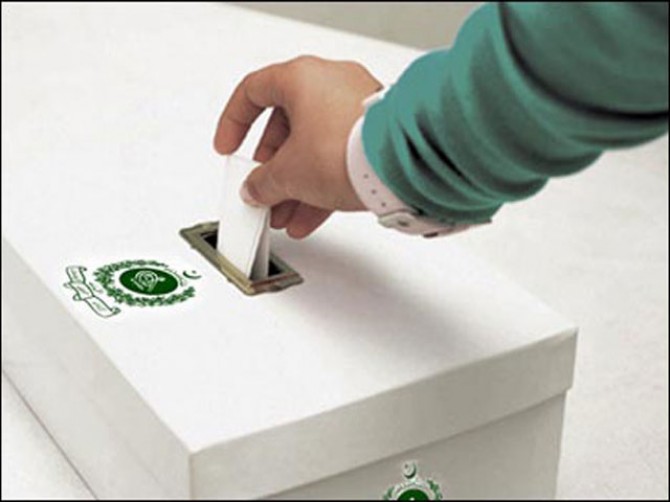
The Pakistan Elections 2013 were widely discussed and there were many analyses predicting no party with a clear majority, a coalition government seemed the most likely result. According to estimates before the elections, no single party gained simple majority in parliament. Out of all the mayhem, PMLN adeptly managed a high number of seats out of a comparatively low percentage of votes. In fact, apart from the MQM it was the only party to win more seats than votes, percentage wise.
The PPP, on the other hand was in a downside with more votes than seats.
It is the norm to prepare predictive analyses of elections through simulations and sample surveys.Operations Research and Systems Analysis (ORSA ) methods are used to derive results, voter turnouts, party positions prior to elections, vote banks of the parties and identification issues are all taken into consideration.
Parties with experience, previous success and voter affiliations are trend setters. The hidden factor of rigging also remains, surely there has hardly been an election in Pakistan without variable levels of rigging. Prior to Elections 2013, there were 44, 027, 567 votes in the electoral lists. PTI petitioned that unverified notes be removed, 37, 186, 053 votes were slashed for being bogus. In 2008 elections, 54% of votes were verified and 34, 980, 069, about 43 percent voters had cast their vote.So to evaluate actual voter turnout, the percentage of voters was halved for the projection. PMLN s share of votes in 2008 was then halved from 26.81 to 13.40, the same was done with all other parties.
After a removal of bogus votes from the electoral rolls , the leading political parties could be badly hit in case of high voter turnout. If the voter turnout remained low like 20%, their fixed vote banks would save the day for them. In case of higher turnout, the new votes could deal the older contenders a decisive blow. So consequently, PTI talked of a tsunami as it had motivated and mobilized many new voters to oust out the old parties.
In Election 2013, voter turnout was good yet lower than expected, from 43.65% in 2008, it increased to 55.02 %. PMLN stood at 26.25% votes while MQM stood at 10.57% of the votes.The new contender, PTI got 19.11% votes.
Now the point to ponder is that if the old vote banks of the experienced political parties had saved them, where had the 44% new registered voters disappeared?
On election day there was an amazing voter turnout, not seen in years. Some voters even had to be sent away without voting as polling ended. Polling was excruciatingly slow at many places and that gives rise to the suspicion that maybe it was deliberate.
Nobody knows the exact percentage of rejected votes and whether they could have made a difference.
Among all the political parties, only MQM and PPP showed a higher voter turnout percentage and this leads us to the reason why most rigging allegations centered on Punjab and urban Sindh. PMLN had 26.25% of the new registered voters while PTI had 19.11%, still votes cast in favour of PTI were still less than its total membership. Keeping in mind that voters need not be allied with any party and still vote in its favour is also a factor to be considered as all three of these parties showed a rise in popularity in these elections.
The PMLN /PTI ratio was 1.94 to 1, this means PTI might have won more seats especially as it gave the PMLN a close competition. In some constituencies, counted votes were much higher than those registered, maybe rejected votes also got counted. The predictions for PPP and other parties were accurate, only PMLN got many more seats than expected and PTI far fewer. It had been predicted that PTI would get 130 to 140 seats if there were a voter turnout more than 40%.
All this goes to show that election statistics given by ECP are beyond calculation, every analysis had gone off the mark. Rigging has happened at some level in most elections held in Pakistan, mostly happening at the level of returning officers. Also, the distortion or discrepancy between seats and votes is a result of the system, which works in favour of the bigger parties and harms smaller parties which find no representation in the parliament.
NA118 is one constituency where the winner received 103346 votes compared to PTI, s 43616, results were announced after two days. In November 2013 , the election tribunal agreed to verification by NADRA. Justice Munir Mughal was appointed Court Commission to oversee the verification. 94 sealed polling bags were received out of the total 325 bags, others were tampered.65 bags were unauthorized and not the property of the ECP. There was no record available for 88000 votes and 36000 had incomplete records.
So, only 44000 votes could ve verified out of 170000, thumb verifications could have dropped the count of verifiable votes even further. The ECP had sent the votes to NADRA for thumbprint verification, it is said NADRA officials tampered with the votes while switching off CCTV cameras installed in the office.Before this incident, the NADRA chairman was sacked as soon as he confirmed that technology is there to verify thumbprints of voters.
Such incidents really damaged the credibility of the ECP, and recently NADRA has pointed out further irregularities in NA 118. A report has revealed that 143 bags containing the election record of the constituency do not belong to the Election Commission of Pakistan, the record was fpund in rice, fertilizer and private bags. NADRA has also pointed out thousands of unauthenticated votes in the constituency, ranging from mismatching of thumb impressions to invalid National Identity Cards.
The counterfoils of 4043 votes were cast on CNIC s never issued by NADRA, 272 counterfoils had no thumb impression and 142 votes were polled by unregistered voters. Most probably, the election result in NA 118 will be declared invalid. This is just one constituency, what would be the real election results if all constituencies all over Pakistan were re-verified officially, surely many voting scams would be revealed.
This month the Election Commission of Pakistan has told the apex court that the whole election scheme in the 2013 elections was planned by returning officers. Previously in a 2012 judgement, the apex court had asked the ECP to introduce election reforms, at that time the ECP had informed the honourable court that it had appointed district returning officers, returning officers as well as assistant returning officers.
And now the ECP admits it is returning officers responsible for the election scam. The main issue is that the ECP never asserted itself and never used the all-pervasive powers entrusted in the commission, it is quite pathetic that now it has to admit the entire polling fraud was framed by ROs. The ECP has to accept responsibility for the whole fraudulent exercise now.
Elections in Pakistan have never been as controversial as the Elections 2013, it is not a very pleasant experience to vote anyway as the system is disorganised and sluggish. Still these elections had galvanised, emotional young voters, social media and television media had given more reach to political parties, their rallies and campaigns. Such a large voter turnout could have played a very positive role in strengthening democracy in Pakistan.
The present ruling party has won many more seats than its ratio, the ECP can play a decisive part by exposing all the discrepancies in election statistics due to rampant rigging. The disillusioned public wants to know the truth, if the ECP endeavours to audit the entire election it might come across the biggest fraud in Pakistan,s history.
By: Sabena Siddiqi
Tags: article, Fair or Foul, opinion, pakistan elections




Leave a Reply
You must be logged in to post a comment.