
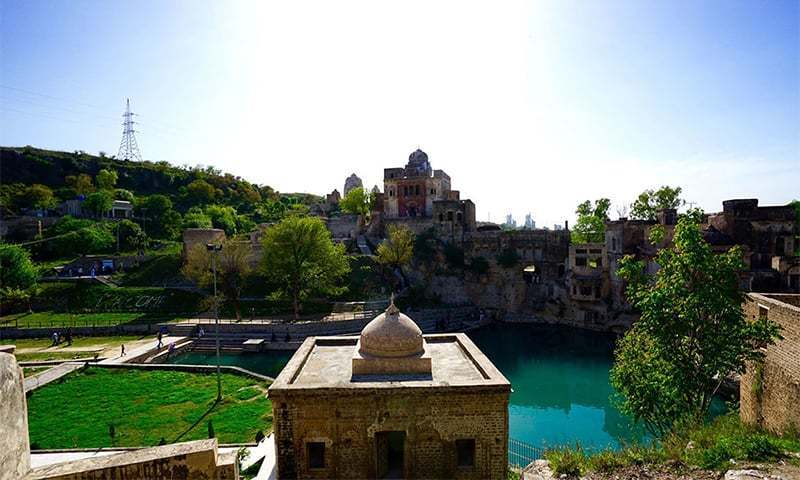
Katas Raj, a collection of temples preserving 1500 years old history from Buddhist era to British rule. Katas Raj lies in Chakwal district, Punjab. The temples were put together by Hindu royalty and are dedicated to Lord Shiva. The grandeur of the conglomeration can be imagined by the fact that it has more than hundred temples build over centuries by the royalty. The complex is traditionally believed to date back to the Mahabharata era. The history states that the pond at Katas Raj was formed by the tears of Lord Shiva after the death of his wife. It’s a derivation form Sanskrit word kataksha, meaning “teary eyes.”
The architecture of the complex is quite attractive. The temples are built over square platforms decorated with series of crowns with small row of pillars, round off by a ribbed dome. Historical records suggest many of the temples were built in 11th century CE in the Kashmiri architectural tradition, at the time when this region, along with parts of Punjab, fell under a Kashmiri kingdom.
Katas Raj is also famous for civilizations and religious convergence. Besides temples at Katas Raj there is also has a Buddhist Stupa. There are remains of a Gurdawara within range of Katas Raj. All these structures are scattered all over the place in the region of Katas.
Pond at Katas Raj has a length of 122 ft. References quote that there is a small river having 300 yards depth just beneath the pond at Katas. Upon exploration by British archaeologists, it was assumed that the Katas pond is formed from water that comes out of a series of natural springs found in the upper reaches of Jhelum. “Pond is carved out of rock and is partially manmade,” Tazkara-e-Jhelum.
Yearly hundreds of visitors come to Katas Raj. Almost every year dreadful events happened to swimmers of the pond. Pond is as deep as 150 feet, many dead bodies are found there. Pond is inhabited by around 400-500 Grass cutter and Gulfam fish, each weighing eight to ten kilograms. The department responsible of the Katas Raj nourishes these fishes. During hot weather the fish comes above the pool level, as the grass at the surface of pool is cut by the grass cutter fish.
Historically mentioned evidences suggest that there are number of streams deep under the surface of pond itself and under the temples as well. Nowadays, the pond is much depreciated now while originally it was 70 yards long and 50 yards wide. On the basis of media reports, a suo motu case was taken up by the Supreme Court of Pakistan. Katas pond is drying up because of several reasons. Chiefly, the cement factories neighboring Katas were extracting huge amounts of water through number of wells, severely depleting the water table of the whole neighborhood. Secondly, the settlements near the Katas Raj lack proper water supply system which results in over drawing of water through bored wells. Thirdly, the plantation of eucalyptus in the area is unchecked which has further complicated the condition.
Cement factories near the Katas Raj temple are the principal culprit. Katas Raj lies in the mineral-rich salt range having four cement plants. Among four, one is only 2 Km away from the historical site. Though the cement plant operates on dry process (process not involving consumption of water), large amount of water is still required to meet the requirements of the staff at plant and for the cooling towers. The factory is allowed to extract 148m3/hr water through 14 tube wells. The current situation forced the Chakwal administration to order closure of 3 tube-wells; later on 2 more tube-wells were closed to lessen the stress on aquifer. Currently, 9 are working.
In addition to cement factories, the region is active for coal mine operations. Since for coal extraction considerable excavating is done, the site becomes exposed to torrents of water gushing out from the earth capillaries.
Aforementioned reasons had put the aquifer feeding the pond under severe stress and subsequent reduction in water table. Katas Raj complex is under the agenda for renovation by National History and Literary Heritage Division. Though the authorities are taking mitigation measures yet there is dire need of radical and sustainable water management and conservation strategies.
by: Marria Ghalib
Tags: 1500 Years of History, Katas Raj




Leave a Reply
You must be logged in to post a comment.