
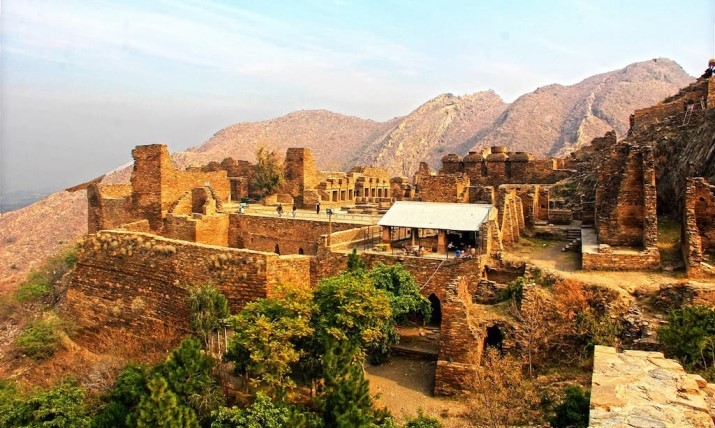
Takht-i-Bahi is located 80 kilometers from Peshawar and 16 kilometers northwest of Mardan in Khyber Pakhtunkhwa, Pakistan. It is a heritage site lies on the northern slope near Takht-i-Bahi village and comprises. This site is of significant importance because it is the largest Buddhist remains in the ancient kingdom of Gandhara. Takht-i-Bahi offers a glimpse of a Buddhist monastery of great historical importance.
Takht-i-Bahi was declared a world heritage site by UNESCO in 1980. The impressive archaeological site was first identified from the extant travel records of the Chinese monk-pilgrim Xuanzang who travelled through greater India in search of Buddhist texts. The site has been damaged because today it is not like what it was in ancient times. In modern times, the first to mention the site, in 1836, was a French officer in the service of Maharaja Ranjit Singh (1780–1839) named General Court. It was explored by the Indian-born British medical officer Dr. Henry Walter Bellew in 1864 as part of an archaeological survey, leading to a series of excavations, and from 1910–11, Harold Hargreaves conducted research on the site.
In Persian and Urdu, the word “takht” means “throne” or “top,” and “bahi” means “water” or “spring.” Together, the meaning is “spring at the top,” and the monastery seems therefore to have been called Takht-i-Bahi because of its location at the top of a mountain, next to a stream. Local residents believe that it was named after the spring on the left of the site.
Some recent studies by the Department of Archaeology and Museums in Peshawar suggest that the site was developed as a Buddhist monastery complex from the 1st century BCE, commencing in the reign of the Parthian ruler Gondophares I and continuing through the reigns of the Kushan emperor Kanishka I, the later Kushan kings Kanishka III and Vasudeva II the Kidara Kushan rulers, and the Huns. On the basis of its structures, the department has divided the construction into four distinct periods.
The first phase includes the construction of the stupa court— a cluster of stupas located in a central courtyard—and the monastery itself, along with kitchen and refectory, which were built from the 1st century BCE–2nd century CE; the main stupa court and assembly hall are said to belong to the second phase, or the 3rd–4th century; the court of three stupas is thought to be from the third phase, or 4th and 5th centuries; and the tantric complex, consisting of small, low-level chambers (meditation cells) and open courtyard are attributed to the fourth phase, spanning the 6th–7th century. The monastery complex is quite exceptional in design, and the arrangement of small shrines surrounding the main stupa court especially worthy of note.
The multiplicity of archaeological layers that make up the site attests to the complex history of its construction and expansion. The structures described above, as well as many other one- and two-story secular buildings uncovered during excavation, are stone-built in the Gandharan diaper-masonry style using local or semi-dressed stone blocks with flakes, set in lime and mud mortar. The site is a great source of historical information not only for Buddhists, but also for the history of Pakistan as a whole.
The archaeological evidence from the site is extraordinarily rich. Many Gandharan sculptural remains have been excavated, including intact statues as well as fragments in unfired clay, stucco, and terracotta. Many of the images contain small sockets for affixing and supporting the bodies and heads of clay. Stucco images recovered from the site can also be seen in various European museums.
According to the studies, if an earthquake strikes the region, the monument is in danger of collapse. The site has also been damaged by quarrying, and through blasting at nearby mines. Some of the walls have been further affected by rainwater. Reportedly, only five engineers are working to protect a total of 74 historical sites in the province—not enough to keep them all in a good state of repair.
by: Abeer Arshad




Leave a Reply
You must be logged in to post a comment.