
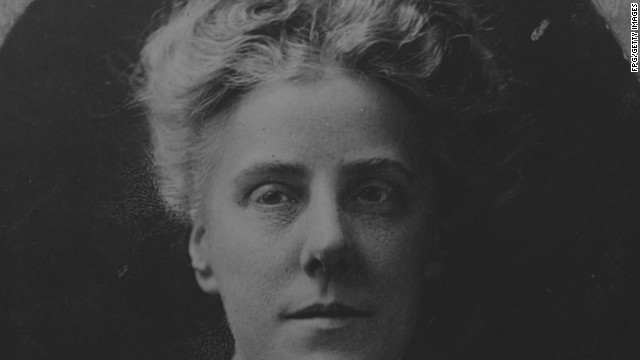
As Mother’s Day turns 100 this year, it’s known mostly as a time for brunches, gifts, cards, and general outpourings of love and appreciation.
But the holiday has more somber roots: It was founded for mourning women to remember fallen soldiers and work for peace. And when the holiday went commercial, its greatest champion, Anna Jarvis, gave everything to fight it, dying penniless and broken in a sanitarium.
It all started in the 1850s, when West Virginia women’s organizer Ann Reeves Jarvis—Anna’s mother—held Mother’s Day work clubs to improve sanitary conditions and try to lower infant mortality by fighting disease and curbing milk contamination, according to historian Katharine Antolini of West Virginia Wesleyan College. The groups also tended wounded soldiers from both sides during the U.S. Civil War from 1861 to 1865.
In the postwar years Jarvis and other women organized Mother’s Friendship Day picnics and other events as pacifist strategies to unite former foes. Julia Ward Howe, for one—best known as the composer of “The Battle Hymn of the Republic”—issued a widely read “Mother’s Day Proclamation” in 1870, calling for women to take an active political role in promoting peace.
Around the same time, Jarvis had initiated a Mother’s Friendship Day for Union and Confederate loyalists across her state. But it was her daughter Anna who was most responsible for what we call Mother’s Day—and who would spend most of her later life fighting what it had become.
“Mother’s Day,” Not “Mothers’ Day”
Anna Jarvis never had children of her own, but the 1905 death of her own mother inspired her to organize the first Mother’s Day observances in 1908.
On May 10 of that year, families gathered at events in Jarvis’s hometown of Grafton, West Virginia—at a church now renamed the International Mother’s Day Shrine—as well as in Philadelphia, where Jarvis lived at the time, and in several other cities.
Largely through Jarvis’s efforts, Mother’s Day came to be observed in a growing number of cities and states until U.S. President Woodrow Wilson officially set aside the second Sunday in May in 1914 for the holiday.
“For Jarvis it was a day where you’d go home to spend time with your mother and thank her for all that she did,” West Virginia Wesleyan’s Antolini, who wrote “Memorializing Motherhood: Anna Jarvis and the Defense of Her Mother’s Day” as her Ph.D. dissertation, said in a previous interview.
“It wasn’t to celebrate all mothers. It was to celebrate the best mother you’ve ever known—your mother—as a son or a daughter.” That’s why Jarvis stressed the singular “Mother’s Day,” rather than the plural “Mothers’ Day,” Antolini explained.
But Jarvis’s success soon turned to failure, at least in her own eyes.
Storming Mother’s Day
Anna Jarvis’s idea of an intimate Mother’s Day quickly became a commercial gold mine centering on the buying and giving of flowers, candies, and greeting cards—a development that deeply disturbed Jarvis. She set about dedicating herself and her sizable inheritance to returning Mother’s Day to its reverent roots. (See National Geographic’s pictures of motherly love.)
Jarvis incorporated herself as the Mother’s Day International Association and tried to retain some control of the holiday. She organized boycotts, threatened lawsuits, and even attacked First Lady Eleanor Roosevelt for using Mother’s Day to raise funds for charities.
“In 1923 she crashed a convention of confectioners in Philadelphia,” Antolini said.
A similar protest followed two years later. “The American War Mothers, which still exists, used Mother’s Day for fund-raising and sold carnations every year,” Antolini said. “Anna resented that, so she crashed their 1925 convention in Philadelphia and was actually arrested for disturbing the peace.”
Jarvis’s fervent attempts to reform Mother’s Day continued until at least the early 1940s. In 1948 she died at 84 in Philadelphia’s Marshall Square Sanitarium…. see more
source: National Geographic news
Tags: Mother's Day history, women




Leave a Reply
You must be logged in to post a comment.