
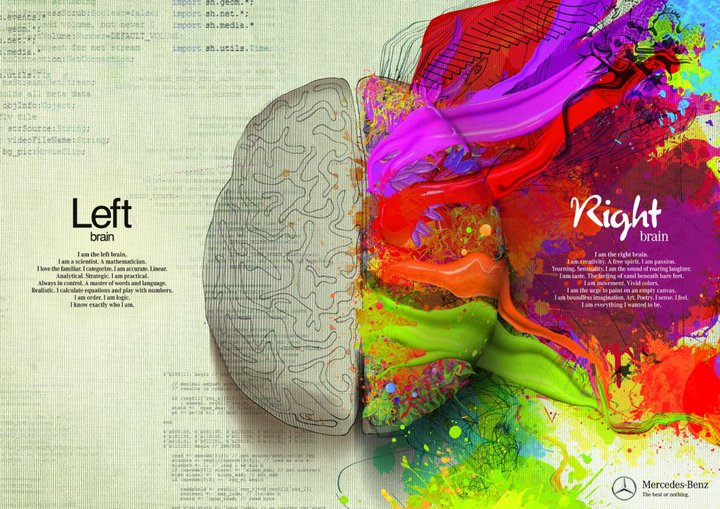
According to the theory of left-brain or right-brain dominance, each side of the brain controls different types of thinking. Additionally, people are said to prefer one type of thinking over the other. For example, a person who is “left-brained” is often said to be more logical, analytical and objective, while a person who is “right-brained” is said to be more intuitive, thoughtful and subjective.
In psychology, the theory is based on what is known as the lateralization of brain function. So does one side of the brain really control specific functions? Are people either left-brained or right-brained? Like many popular psychology myths, this one has a basis in fact that has been dramatically distorted and exaggerated.
The right brain-left brain theory grew out of the work of Roger W. Sperry, who was awarded the Nobel Prize in 1981. While studying the effects of epilepsy, Sperry discovered that cutting the corpus collosum (the structure that connects the two hemispheres of the brain) could reduce or eliminate seizures.
However, these patients also experienced other symptoms after the communication pathway between the two sides of the brain was cut. For example, many split-brain patients found themselves unable to name objects that were processed by the right side of the brain, but were able to name objects that were processed by the left-side of the brain. Based on this information, Sperry suggested that language was controlled by the left-side of the brain.
Later research has shown that the brain is not nearly as dichotomous as once thought. For example, recent research has shown that abilities in subjects such as math are actually strongest when both halves of the brain work together.
According to the left-brain, right-brain dominance theory, the right side of the brain is best at expressive and creative tasks. Some of the abilities that are popularly associated with the right side of the brain include:
The left-side of the brain is considered to be adept at tasks that involve logic, language and analytical thinking. The left-brain is often described as being better at:
Sam, a fourth grade student, starts to draw every time I teach a new concept or explain an assignment. We’ve been in school for only two weeks why is he tuning me out already? Dorothy says that she feels ill every time I begin an art lesson, and asks to go see the nurse. Why doesn’t she enjoy art as much as the other children do?
Wouldn’t it be wonderful to start the year with a single plan that would ensure that we could reach all of our students? As we know, such a plan does not exist. The students we teach have diverse learning styles that require different approaches. So how can we adapt our teaching to reach and engage as many of them as possible, as often as possible?
Interestingly, the answer lies in first knowing ourselves as teachers. One way to do this is to understand how our own “neurological style” influences the way we teach. Each one of us has a left-, a right-, or a middle-brain preference, and believe it or not this significantly influences our teaching patterns. By understanding the processes at work in the brain, we can better help our students to explore their own individual preferences.
This quiz will help you learn whether you are a left-, right-, or middle-brain teacher. Please take a few minutes to complete the quiz and tally the results.
Understanding Your Results
You now know whether your preference tends to the left, right, or middle brain, but what does this mean? First, for those of you who came out to be strong to moderate left- or right-brain dominant, be assured that your other hemisphere is alive and well; however, the results do mean that you tend to lead with your dominant hemisphere.
For example, if you are right-brain dominant, it is your intuitive, emotional right hemisphere that guides the decisions you make throughout the day. If you are left-brain dominant, it is your sequential, time-oriented left hemisphere which tells you how to think, what to believe, and what choices to make.
Those who are middle-brain dominant tend to be more flexible than either the left- or the right-brain folks; however, you often vacillate between the two hemispheres when you make decisions. You sometimes get confused when decisions need to be made because, neurologically speaking, you could do most tasks through either a left-brain or a right-brain method!
Our neurological profile essentially guides the way we teach our classes, meaning that left-brain teachers tend to teach in a “left-brain style,” right-brain teachers typically teach in a “right-brain style,” and middle-brain teachers tend to vary their teaching between the two approaches. As you evaluate your own teaching style, remember that none of these guidelines are set in stone, and that we do not always act according to our preferences. As we know, people are complex and so are their behaviors.
Teachers tend to better reach students who share their same neurological strengths. A strong left-brain teacher, for example, will need to make a conscious effort in order to better reach the strong right-brain students in the classroom.
The Left-Brain Teacher
Teachers with left-brain strengths generally prefer to teach using lecture and discussion. To incorporate sequence, they put outlines on the board or overhead, and they like to adhere to prepared time schedules. They give problems to the students to solve independently. Teachers with left-brain preferences assign more research and writing than their right-brain peers. A reasonably quiet, structured classroom is preferred. The classroom tends to be clean, with items in their place.
The Left-Brain Student
Left-brain students prefer to work alone. They like to read independently and incorporate research into their papers. They favor a quiet classroom without a lot of distraction.
Dorothy scores “strong left” on a brain preference test for children. Though Dorothy is not learning disabled, her right hemisphere is significantly weaker than her left. She has great difficulty understanding lessons with a visual-spatial orientation. Dorothy is also a perfectionist. When the fourth-grade teacher initiates an art project, Dorothy believes that she cannot do the work successfully. She is afraid to fail and consequently becomes nauseous. Seeing the nurse accomplishes two things: It gets her away from an unpleasant situation and gives her time to regroup herself prior to Reading time.
Let’s say, for example, that you are introducing a unit on the solar system. Here are some left-brain teaching techniques that will help Dorothy and other strong to moderate left-brain students feel engaged during your lesson:
The Right-Brain Teacher
Teachers with right-brain strengths generally prefer to use hands-on activities over a lecture format. In concert with the right-brain preference of seeing the whole picture, these teachers incorporate more art, manipulatives, visuals, and music into their lessons. They tend to embrace Howard Gardner’s multiple intelligences. They like to assign more group projects and activities, and prefer a busy, active, noisy classroom environment. The classroom of a strong right-brain teacher will typically have materials and books scattered all over.
The Right-Brain Student
Right-brain students prefer to work in groups. They like to do art projects, industrial arts electives in middle school, and graphic design. They would prefer to design and make a mobile rather than write “another tedious term paper.”
Sam scores “strong right” on a brain preference test for children. His left hemisphere, though healthy, is significantly weaker than his right. Though Sam does not have a learning disability, he has difficulty processing information that is presented verbally. When the teacher lectures, or talks in compound, complex sentences, Sam gets anxious and overwhelmed and shuts down. The teacher’s words run together, and the meaning becomes garbled. Sam’s drawings comfort him; they are something he knows he can do well. Right-brain activities such as painting and drawing are activities that he can do easily and with pride.
Taking the solar system example, here are some right-brain teaching techniques that will help Sam, and other students with moderate to strong right-brain strengths, get the most out of your lesson:
A Teaching Challenge
Students with strong left- or right-brain tendencies much prefer to be taught to their neurological strengths. Although they can learn by different methods, they get most excited and involved when they can learn and do assignments in their area of strength.
The good news is that we can all strengthen the weaker parts of our brains. Researchers tell us that our brains are always searching for new meanings and adding new neural circuits to make connections.
I am a left-brain teacher who, by nature, strongly prefers to teach using lecture and discussion based upon research and experience. I typically put an outline of the lesson on the board and distribute packets of handouts to accompany each lesson. Twelve years ago, I began reading brain-based research and realized that by being left-brain dominant, I was only engaging my left-brain learners and some students with middle-brain strengths. The poor right-brain learners, and many middle-brain students, must have been overwhelmed from all of the auditory input.
Over the past ten years I have gradually added overheads, videos, role-playing, simulations, group work, group assignments, and end-of-the-year group projects into my classes. I now feel that I am making my best effort to reach my left-, middle-, and right-brain learners. In doing this, I have mastered some exciting right-brained techniques as well.
Why not incorporate a new “neurological teaching method” into your classes this fall? If you are a left-brain teacher, try adding at least one right-brain methodology (overheads, videos, music, role playing, dance, or group projects) into your lessons. If you are a right-brain teacher, try adding more direct teaching, lecturing more often, or assigning more individual and/or research-oriented projects. If you are a middle-brain teacher, select and incorporate something new from either area.
I also recommend giving your students a variety of assignments to choose from each week. For example, let’s say you plan to assign a book report. Let each student choose from one of the following: write the report using an outline; present the report from an outline; draw and color a major scene from the book; design and create a mobile, poster, or diorama; dance a scene from the book; or create a different ending to the book. It is fascinating to watch students gravitate towards their neurological strengths when given a choice of assignments. Those with moderate to strong right-brain strengths will choose to draw, act, or create. Those with the left-brain preference will write or speak.
I believe that it is good practice to tell our students that we each have our own individual neurological strengths and weaknesses. Feel free to use your own results as an example, explaining that you do not expect everyone to be perfect in every area. These messages will help students see that you are on their side. They will be grateful that you understand them enough to assign projects and assignments in their area of strength, and they will be relieved to know it is okay to learn the way they most enjoy learning.
Diane Connell, Ed.D. is currently an associate professor and director of the Graduate Programs in Learning Disabilities at Rivier College in Nashua, New Hampshire. She has taught at the elementary and high school levels. Dr. Connell can be reached at [email protected]
Cognitive-Style Quiz
Choose the one sentence that is more true. Do not leave any blanks.
To Score
From The Alert Scale of Cognitive Style, by Dr. Loren D. Crane, Western Michigan University, 1989. Reprinted with permission.
Preferences of the Two Sides of the Brain
Description of the Left-Hemisphere Functions
Constantly monitors our sequential, ongoing behavior
Responsible for awareness of time, sequence, details, and order
Responsible for auditory receptive and verbal expressive strengths
Specializes in words, logic, analytical thinking, reading, and writing
Responsible for boundaries and knowing right from wrong
Knows and respects rules and deadlines
Description of the Right-Hemisphere Functions
Alerts us to novelty; tells us when someone is lying or making a joke
Specializes in understanding the whole picture
Specializes in music, art, visual-spatial and/or visual-motor activities
Helps us form mental images when we read and/or converse
Responsible for intuitive and emotional responses.
Helps us to form and maintain relationships
http://psychology.about.com/
http://www.scholastic.com/
Tags: Brain Theory, Left Brain, Left Brain - Right Brain, Right Brain



Leave a Reply
You must be logged in to post a comment.