
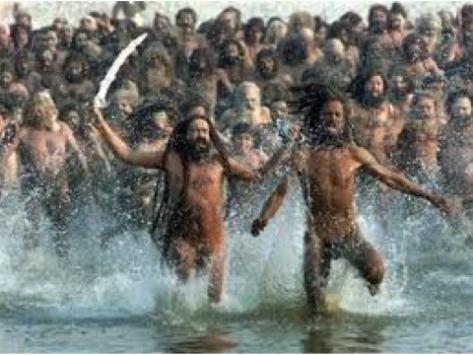
Tens of thousands of pilgrims led by Naga Sadhus, the naked ash-covered holy men entered the sacred river Ganga on Monday for the ‘Shahi Snan’ as the world’s biggest religious festival, the Maha Kumbh Mela started in Allahabad.
At dawn on Monday at a time chosen by astrologers as auspicious, hundreds of holy men from 13 akharas, some brandishing swords and tridents, ran into the swirling and freezing waters for the first bath- the Shahi Snan, signalling the start of events.
The Shahi Snan is a very distinctive and attractive feature in the Kumbh and marks the official beginning of Kumbh.
The Kumbh Mela in Allahabad will see up to 100 million people gather over the next 55 days to take a ritual bath in the holy waters, believed to cleanse sins and bestow blessings.
The 13 akharas founded by Adi Shankaracharya for the safety and protection of ‘sanatan dharma’ will have three shahi snans (royal baths) — on January 14 (Makar Sankranti), February 10 (Mauni Amavasya) and February 15 (Basant Panchami).
Assorted holymen, seers and self-proclaimed saints from all over the country have assembled for a colourful spectacle that offers a rare glimpse of the dizzying variety of Indian spiritualism.
“Our biggest wish is that there is peace and that people should look after each other,” one Naga Sadhu, a devout, fierce and famously nude sect of followers of the Hindu god Shiva, told AFP.
For most, however, attending the Kumbh Mela is a religious holiday enjoyed in an almost carnival atmosphere, where prayers and blessings are offered and sought alongside family or friends camping together at the vast festival site.
“You feel somewhat connected to somebody who is there above, and that’s what it’s all about,” Mayank Pandey, a 35-year-old computer science professor, explained.
The Kumbh Mela takes place every 12 years in Allahabad in northern Uttar Pradesh, with smaller but similar events every three years in other locations around the country.
It has its origins in Hindu mythology, which tells how a few drops of the nectar of immortality fell on the four places that host the festival — Allahabad, Nasik, Ujjain and Haridwar.
For men like Ram Krishna Verma, a 42-year-old farmer from Chattisgarh who has travelled 700 kilometres (430 miles), it is a time of religious duty as he has come to scatter the ashes of his late mother.
“She died two months ago,” he said. “This is the final resting place.”
The holy river Ganga is worshipped as a god and is seen as both the giver and taker of life. Most devotees dunk their heads under the water, some drink it and others bottle it and take it home as a gift.
“Those who are poor will become rich and those who don’t have children will get children,” explained Bhim Sen, a 61-year-old farmer from southern India. “I pray to the Ganges that my wishes will become fulfilled.”
Police expect 250,000 people on Monday with 20 million anticipated on February 15, the most auspicious day. Overall, organisers are counting on about 100 million coming, the same number as in 2001.
The management of the festival requires a monumental effort — and a budget of 16 trillion rupees ($290 million) — but officials say everything is in place for a safe and successful event.
Top state police officer Arun Kumar said the biggest concern was crowd control and the 12,000 officers on duty would be monitoring to guard against stampedes — a frequent and deadly occurrence at Indian religious festivals.
“We will be measuring the pressures in the crowd,” Kumar, who is in charge of law and order, said on Sunday. “We are totally prepared to handle this Mela.”
Organisers have set up 35,000 toilets, 14 medical centres, 22,000 street lights, 150 kilometres (93 miles) of temporary roads, 18 bridges, and new sewage facilities.
Nearly 7,000 buses as well as hundreds of special trains are expected to ferry people to and from Allahabad where the heavily polluted Yamuna river flows into the equally dirty Ganga.
Despite its important role in Hinduism, the Ganga is tainted by industry and the settlements along its banks, which quickly turn the clear waters from the Himalayas into a murky, frothy brown downstream.
Local authorities have cracked down on untreated effluent from nearby factories and new drainage facilities in Allahabad have cut the immediate flow of raw sewage. – hindustantimes.com
Tags: India, spiritual gathering, Tens thousands




Leave a Reply
You must be logged in to post a comment.