
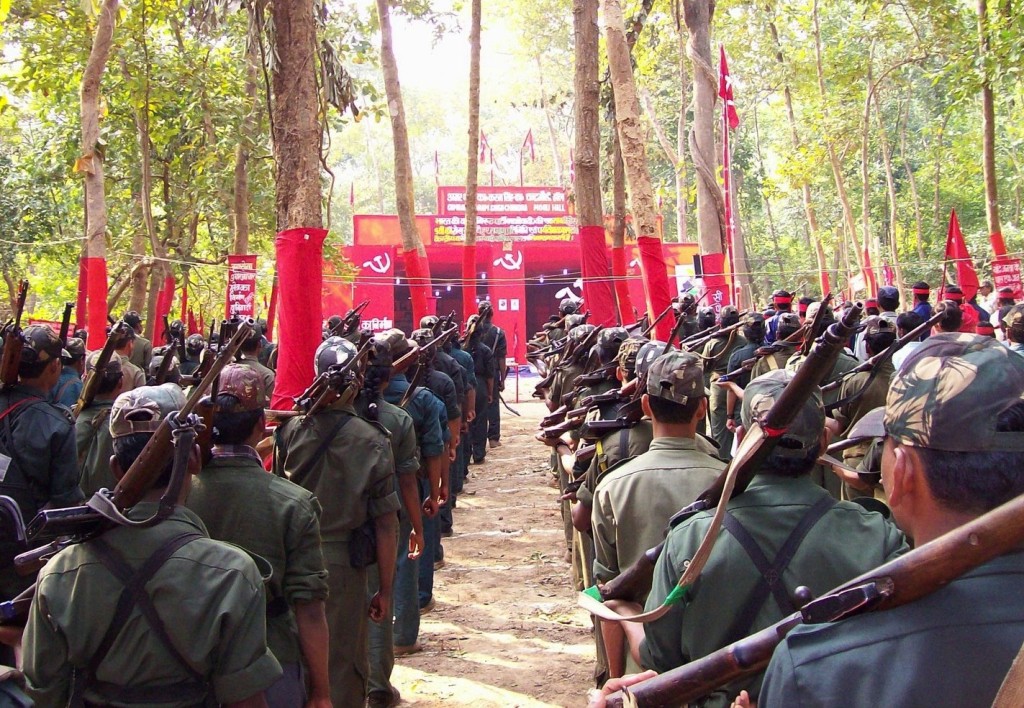
The Naxalite/Maoist is India’s most violent insurgency movement after Kashmir. It has continued to defy the state for longer than any other uprising in India , the insurgent strategy of the Naxalites can be compared to that of the Maoists in China .
Naxal movement in India started on 25th May 1967 from Naxalbari village of Siliguri sub-division of Darjeeling district of west Bengal, as a violent struggle of natives. At that time there was a world-wide stance against capitalism. Marxism-Leninism-Maoism is the ideological basis ,immediate aim of the Communist Party was to complete a new democratic revolution in India as a part of the world proletarian revolution by overthrowing th e semi-colonial, semi-feudal system under neo- colonial form of indirect rule, exploitation and control and the three targets were ; —imperialism, feudalism and big bourgeoisie.
The elite rich was to be overthrown and there would be an equal distribution of wealth. The revolution would be carried out and completed through armed agrarian revolutionary war i.e. the Protracted People’s War with area wise seizure of power remaining as its central task. Encircling the cities from the countryside and thereby finally capturing them was the main strategy.
The Naxalbari upsurge was sparked by the fact that land reforms were still ineffectual. Its sustenance was fuelled by class and caste tensions and the sense of desperation due to the prevailing economic and social conditions.The ideology gained momentum in the seventies, among the youth and the intellectual circles in many parts of India. Communism is not that popular any more , specially after the downfall of the USSR . It has been somewhat modified and consumerism has now been introduced in China where it was previously unheard of.
The Naxalites endorse Maoism /Leninism /Marxism , it still has to be seen how they apply it wherever they are in control. Since its inception its support fluctuated in each decade , its most recent manifestation is the result of a 2004 decision by two Maoist groupings, the People’s War Group and the Maoist Communist Centre, to join forces to form the Communist Party of India (Maoist). It has significant presence in the states of Kerala, West Bengal and Tripura. As of 2011, CPI(M) is leading the state government in Tripura. It leads the Left Front coalition of leftist parties in other states and the national parliament of India, they have 543 seats.
This post-2004 incarnation of the Naxalite insurgency has been one of the most sustained — and perhaps the most lethal. They are much more successful in their objectives now than in the past, the present Maoist insurgents are better equipped and properly trained to wage guerilla warfare. The present Maoist insurgents are better equipped and properly trained to wage guerilla warfare. They have learnt from their past mistakes, which were committed by their leaders. According to guerilla warfare principle, the leaders should learn from mistakes and change the strategy accordingly.
Until now, urban terrorism has been avoided, the mistake and defeat of the urban Maoist insurgency is remembered by the new learners of the revolution.
The Naxal,s prime weakness was lack of weapons ,standardized weapons are a key advantage for organized militias , an advantage the Naxalites lack. Parts and ammunition of a random assortment of weapons are not interchangeable, which is an important tactical limitation.
Another factor was their primary focus on villages , concentrating on the urban poor would have been more effective and speeded up the revolution . The Naxalite style of killing asked for revenge and retribution which made the backlash worse for them . Many fake encounters occurred with police forces in a vengeful mood with so many policemen being killed. ‘Bandh ‘ when the Maoists want a strike or want to close down anything .Khatam line’ – is the policy of targeted killing of individuals. These two practices also caused unnecessary complications and gave the whole movement a Mafia image . When a bandh is declared by the Naxalites, it has an implied threat of violence to enforce work stoppage.
The new breed of Naxalites is far better grounded in ideology. Their weaponry is much better and they are better equipped to take advantage of the administration’s failings. Down the years the whole movement has acquired a predominantly rural or tribal character where lower castes and marginal groups in the social hierarchy now form the core of its support base. The movement is on the rise and its influence among the poor and downtrodden is growing. Despite tremendous state repression accompanied by martyrdom and killings, the flow of fresh cadres to its ranks is not dwindling. Today it can claim to be one of the strongest revolutionary left movements in the world, those only next to the Philippines, Peru and Nepal.
They are working in accordance with Mao’s “protracted people’s war” strategy. The method of t he Naxal/ Maoist movement is to organize revolution on the pattern of Maoist revolution of China through armed and violent struggle. Their main strategy is to control first rural then urban area and finally capture political authority. They do not have faith in parliament and peaceful changes. The Naxalite organization is a sophisticated one that relies not only on militant tactics but also on social unrest and political tactics to increase its power. Naxalites have formed sympathetic student groups in universities, and human-rights groups This ideology has attracted not only peasants but urban educated middle class youth as well. Medical and engineering students are also part of the rebellion disillusioned by the corrupt political system . They seize political power by initially transforming rural areas into guerrilla zones and subsequently into liberated zones.
It is a paradox that ‘Shining India ‘ finds itself in the throes of an agrarian rebellion inspired by an ideology that is passé în most of the world. India is a fast growing economy but does not benefit the poor who are in overwhelming majority. India houses one of the largest poorest populations in the world. India grows only sector-wise, it has been called the poorest nation in the world according to a World Bank report this year. Nehru´s policies of idolizing heavy industries before developing the man-power infrastructure have harmed the Indian economy. Despite liberalization the benefits of ‘India Shining’ do not reach 90 per cent of Indian’s economic growth in India has not trickled down, a political liability that the Naxalites have taken advantage of.
The fiery ideologies work by envisioning a spontaneous mass upsurge all over India that would create a ‘liberated zone’. The Naxalite movement came into being as a result of prevailing social and economic issues. They were highly repressed, tortured and their leaders were killed today 14 out of the 28 States of India feel the dangerous presence of these Naxalites .
They want to topple the Indian state by force and intended to achieve this by 1975 but have since compromised and now aspire to control India by 2016. Naxalite-Maoist insurgency is establishing itself as the biggest threat to the internal security of India.
Naxals attacked a political rally in state of Chattisgarh on 25th May , killing 28 ministers. The Maoists blamed chief minister Raman Singh, Manmohan Singh , Sonia Gandhi and others for keeping mum when innocent people were killed what they termed as state sponsored violence. Nothing has exposed the inherent flaws in India’s anti-Naxalite policy and in its implementation on the ground more vividly than this brutal massacre of the top brass of the Congress in Chhattisgarh.
The Indian security forces have begun a major offensive against Naxalites. Using satellite technology large areas of India have been mapped . Altogether more than 80000 security forces are deployed to recapture Naxalite areas Indian government has ordered number of sophisticated UAVs from U.S to spearhead the operation. Two months ago Indian security forces started a major operation in West Bengal state to recapture hundreds of villages occupied by Communist Party (Maoist) aka Naxalites. Previously dubious schemes such as the Salwa Judum, an anti-Naxalite militia ,failed to get the security agencies to work in tandem within an institutionalised framework. An ambush was carried out by the Communist Party of India , in the Karmatiya forests in Latehar District, Jharkhand in January 2013. The new tactic of the Maoists is implanting IEDs in dead bodies of their adversaries to cause more casualties.
This ‘Body trap’ strategy of the Maoists has never been witnessed before in the history of the Naxal Movement. They keep employing new tactics constantly which makes them even more unpredictable and dangerous , it has even been claimed they learn tactics from Hollywood action movies and their mercenaries are given CDs to watch and pick up methods from. They employ a wide range of low-intensity guerrilla tactics against government institutions, officials, security forces and paramilitary groups. An average of almost 500-600 people are killed every year in the past decade due to Naxal violent clashes , a good percentage of which is always civilians.
The biggest Naxal attack up till now was in April , 2010,at least 75 personnel of CRPF were killed in an ambush by Naxalites in Chhattisgarh. According to officials, the Naxalites attacked a CRPF convoy in the Tademetla forests. Waiting on hilltops, they opened indiscriminate fire and triggered an IED blast as the convoy appeared. 1,000 Naxals were part of the attack while the CRPF team had only 120 personnel.
Vietnamese and Israeli help has been sought by the Indian government in the latest counterinsurgency operations against the Naxalites. The Naxals are a big threat to business and industry as some of the railways and mining towns are in their strongholds , they can close down railway lines and entire cities with ‘Bandh’ and ‘Khatam’ is used for exterminating enemies. Some of the most violent attacks conducted by the Naxalites have been against freight and police transport trains, killing dozens of people at a time. Naxalites’ constantly sabotage roads by planting improvised explosive devices under road surfaces or simply digging roads up. Naxalites view roads as a means for the government to send its forces into their territory and does not let the Indian government start any development projects.
Home minister has banned Communist Party (Maoist) and called Naxalites as the biggest threat to Indian State.Indeed, Indian Prime Minister Manmohan Singh has labeled the Naxalites “the biggest internal security challenge” to India. It is the most topical and fastest-growing movement in India , Naxalites are often referred to by the state as a “virus”. Now Naxalites are active in 40% of India’s land area. They are active in Chhattisgarh, Orissa, Andhra Pradesh, Maharashtra, Jharkhand, Bihar, Uttar Pradesh, and West Bengal states. Out of these states they control more than 40% of the land area in Chhattisgarh and Jharkhand states and they spread fast . They have virtually spread to over 20 per cent of the total districts in India.
The Maoists almost run a parallel government ,anyone who understands Maoist tactics needs no specific intelligence inputs to know that anyone could be the target of an attack in what is referred to as the Red Corridor. Most political parties survive in Naxal areas by bribing them to stay safe. Naxal rebellion also benefited from the ongoing drought in India which affected peasants drastically. Difficulties like starvation and disease brought more farmers into the folds of the Naxalite movement. The government has not given peasants any relief ,270,000 farmers have committed suicide since 1995 . Naxalites claim support by the poorest rural populations, especially Adivasis.
On a grander geopolitical level, the Naxalites can be viewed through the prism of Chinese-Indian rivalry. In the beginning there was mutual rhetorical support between the Maoist regime in China and the Naxalites in India. The advent and growth of the Naxalite movement certainly did serve China’s goal of weakening its largest neighbor to the south. The Indians have always feared outside powers would manipulate grassroots rebel groups in India and further destabilize an already regionalized country.
In 2011, Indian police accused the Chinese government of providing sanctuary to the movement’s leaders, and accused Pakistani ISI of providing financial support.
When the Naxalite movement began in the 1960s, New Delhi feared Beijing was trying to get a foothold in India, and for the past 50 years India has demonized Pakistan’s Inter-Services Intelligence directorate (ISI) for allegedly supporting militant operations in India. There is no evidence available to prove these allegations. Naxalite leaders in India deny cooperating with Pakistan but have very publicly pledged their support for all separatist movements in India.
Alarmist visions linking Naxalites to militant groups supposedly backed by Pakistan, India’s main geopolitical rival is the ultimate “nightmare” scenario for India. The Naxalite arsenal is vast and diverse, consisting of weapons manufactured in China, Russia, the United States, Pakistan and India.
The lack of weapons uniformity among Naxalite groups indicates they have no benefactor to bestow a reliable, standardized arsenal and have had to build up their own from scratch. Naxals are making money from their various resources and are trying to upgrade their weaponry though. The present-day Naxalites are no more confined to traditional weapons and are better equipped than state police forces and use latest modern communication gadgets to track police movements. Gathering intelligence Naxilites interact with Maoists from Nepal, secessionists in India’s restive northeast, Islamists from Bangladesh, criminals from Myanmar and the Liberation Tigers of Tamil Eelam (LTTE) in Sri Lanka. The Naxalites are a low-maintenance, self-sustaining movement that will continue to undermine Indian rule in the country’s east .
“Naxalism” now affects some 170 of India’s 602 districts—a “red corridor” down a swathe of central India from the border with Nepal in the north to Karnataka in the south and covering more than a quarter of India’s land mass. A vast portion of India, from West Bengal in the northeast to Andhra Pradesh in the south, has come under the influence of the Naxalites, the “Red Taliban” as they have been called.
A primitive peasant rebellion based on an outmoded ideology is out of keeping with the modern India of soaring growth, Bollywood dreams and call-centers. Sheer injustice in Indian society has created insurgencies, eg. Dalits make up for the most part of Indian population yet they remained deprived of the benefits of the current economic boom. They are forced into menial jobs, denied entry to temples, cremation grounds and river bathing points and cannot even share a barber with the upper caste Hindu.
Punishments are severe when these boundaries are transgressed. In Tamil Nadu, for instance, 45 special types of ‘untouchability’ practices are common. A violent insurgency in Indian-administered Kashmir has claimed tens of thousands of lives. Its north-eastern states are wracked by dozens of secessionist movements.
The seven states of northeastern India also called the Seven Sisters are significantly different, ethnically and linguistically from the rest of India. These states are rocked by numerous armed and violent insurgencies, seeking separate statehood, autonomy or outright independence, mostly for government neglect. These include Assam, Arunachal Pradesh, Meghalaya, Manipur, Mizoram, Nagaland and Tripura. The Tamil struggle continues till date and is gaining momentum each passing day. India has in all, an estimated 30 armed insurgency movements are sweeping across the country, reflecting an acute sense of alienation on the part of the people involved. Broadly, these can be divided into movements for political rights e.g. Assam, Kashmir and Khalistan Punjab, movements for social and economic justice e.g. Maoist Naxalite and north-eastern states, and religious grounds eg Ladakh.
There are 16 belligerent groups and 68 major organization as terrorist groups in India, which include: nine in the northeast Seven Sisters, four in the center & the east including Maoist/Naxalites, seventeen in the west Sikh separatist groups, and 38 in the northwest Kashmir.
India has an unjust system and no amount of face -saving can hide the barbaric and primitive streak in its very ethos. India has a bad experience of army deployment in the past to address domestic threats.
In the 1980s, use of the army to deal with Sikh militancy was too brutal and brought in a lot of criticism . Military action at the Golden Temple in Amritsar, codenamed Operation Blue Star, also fanned the flames of Sikh militancy and sparked a series of serious counter-attacks like the assassination of Indian PM.
The Indian army is currently fighting separatist forces in Kashmir , along the disputed border with Pakistan, and is dealing with multiple ethno-separatist movements in the northeast region of India surrounded by China and Bangladesh. The Naxalite problem is in certain respects more serious than the Kashmir problem. India certainly needs to develop an effective strategy to deal with the Naxal movement now ,it needed to be ‘nipped in the bud ‘ but instead it was left to fester.
At the same time this year due to the delay in monsoon , drought is feared in many states.
Only 40% of agricultural land is irrigated. Drought coupled with global recession will be a disaster to Indian economy. These conditions will only strengthen and exacerbate the Naxalite movement.
Naxalites have been among the most principled of terrorist groups in selecting their targets.
Their leaders are thinking far into the future, taking a 20- to 25-year view of their struggle. “Liberated” areas would be expanded until they pose a threat even to India’s cities. They talk boldly of expanding Naxalite influence into new areas: Kashmir, the north-east, and India’s cities, the spread of Naxalism is causing justifiable alarm. They dream of seeing the red flag fly over the Red Fort in Delhi in their lifetime.
Rise of insurgencies in India presents a very disturbing scenario, Suhas Chakma, Director of Asian Centre for Human Rights, New Delhi, says that ‘India is at war with itself. In the present globalized world where terrorism and human rights are talked about a lot, surprisingly Naxalite movement is overlooked on both counts. Neither terrorist acts by Naxalites nor their deliberate oppression by the Indian Government has attracted international attention. Think tank Stratfor informed India a few years back that irrespective of the Maoist movement appearing to be fairly contained in India, the rebel group’s leaders could develop the “tradecraft for urban terrorism”,’ The groups leader s and bomb-makers could develop the capability to strike outside the ‘Red Corridor ‘.
Naxal corridor could become a breeding ground for terrorism, stakeholders may be exporting terror from this region to fulfill ambitions across borders on all sides of India. The Naxalite challenge to the state could materialize in other unpredictable ,unforeseen ways. “Naxalites are honing their capacity to construct and deploy IEDs, conduct armed raids and maintain an extensive, agile and responsive intelligence network,” warned Stratfor. Naxalites have expressed the intention to drive multinational corporations out of India and that they would use violence to do so. This threat is backed by a proven tactical ability to strike economic targets , which is a top concern for the Indian government.
If India cannot provide security to multi-nationals and corporate its economy could suffer a setback.
Strong Maoist movement in India is a threat to western capitalism as well , maybe that is why the corporate owned Western media ignores this growing phenomenon ,it is probably perceived as a threat to capitalist powers. Moreover ,as the balance of power tilts towards China in the 21st century , it is possible that a Communist or even semi -Communist India would be more acceptable to the new world power.
China does seem to have a specific strategy concerning India as it has proceeded to encircle it completely and the Ladakh incident seemed like an experiment to test India. The ideal would of course be a system which incorporates good points of both communism and capitalism ,this would make it infinitely more practical as both systems have well-exposed weak points. It is very much possible that communism could become an even stronger movement in the future in India.
At home , Indian media presents a censored version of the news aimed at downplaying the Naxal crisis brewing at home. It is highly unlikely that this ostrich in the sand attitude will wish away the Naxalites . It is becoming more and more obvious that India is struggling unsuccessfully to control all these rebellions . India has to do much more than plan counter-insurgency operations or support violent vigilante groups to suppress the Naxalite movement. Poor strategies and inadequate studies of Naxal principles account for a lack of an effective counter terrorism action. An effective riposte to their violence was a judicious mix of counter terror action and the empowerment of the tribals which would have reduced Naxalite influence.
It is clear that there is a wide chasm between promises and their eventual deliverance, until the Indian government implements employment, poverty alleviation and land reform programs, counterinsurgency measures cannot achieve much. Using strong-arm tactics on Naxalites is not advisable as they have grassroots support of millions of victimized Indians.
The Maoist insurgency is an obstacle in the way of India’s emergence as a world power. , according to one estimate 40% of India’s territory is under some form of Maoist influence. India does not seem willing to combat the Naxals militarily yet ;whenever it decides to start an operation it would face a tough fight against a well-entrenched movement .
By: Sabena Siddiqi
Note: Al-Rasub is not responsible for Writer personal opinion
Tags: article, India, The Naxal Threat




Leave a Reply
You must be logged in to post a comment.