
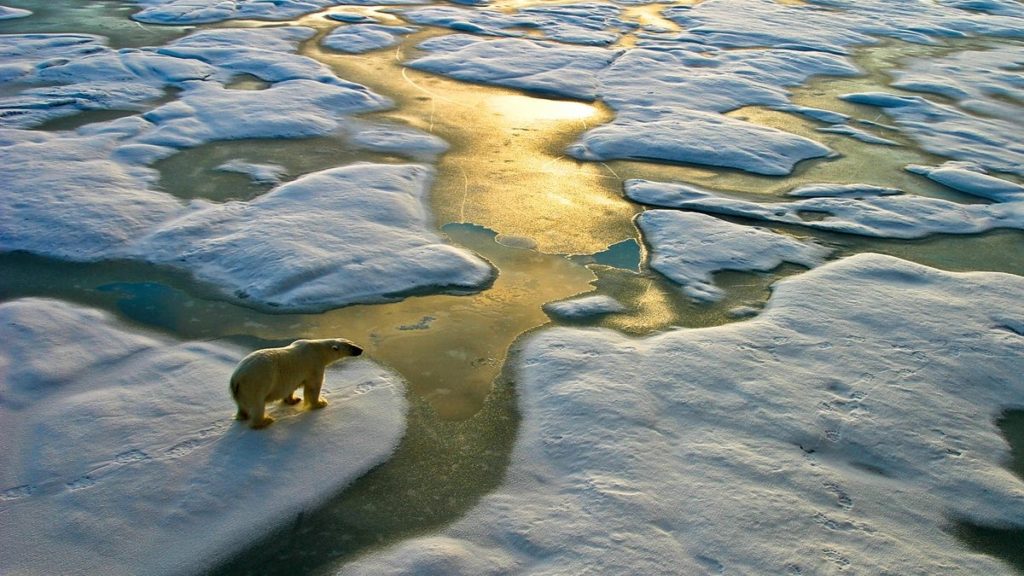
Arctic region is warming far more quickly than anywhere else on the earth. There was an increase of nearly 1.8 degrees Fahrenheit in the past decade. Greenhouse gases produced a s result of anthropogenic activities are predicted to increase the temperature of the North to 7.2 F (4 C) year-round—and top 12.6 F (7 C) in autumns—by the middle of this century. That’s about when the planet as a whole is projected to reach the 3.6 F (2 C) warming often cited as the threshold for disastrous impacts.
High North is already undergoing exceptional changes, including drastic ice losses on land and sea, permafrost thaw, intense wildfires, unexpected storms, earlier springs, and much more. In couple of years, summer sea ice shrank to its second lowest extent since satellite measurements began in 1979, while record July heat melted billions of tons of ice off the Greenland ice sheet. The ice today covers only 50% of the area it covered 40 years ago in late summer. Wildfires blazed across millions of acres from Alaska to Siberia.
According to the Intergovernmental Panel on Climate Change (IPCC), carbon dioxide levels in the atmosphere are higher than at any time in human history. The last time CO2 concentrations reached today’s level was 3 million years ago, during the Pliocene Epoch. As geoscientists who study the evolution of Earth’s climate and how it creates conditions for life, we see evolving conditions in the Arctic as an indicator of how climate change could transform the planet. If global greenhouse gas emissions continue to rise, they could return the Earth to Pliocene conditions, with higher sea levels, shifted weather patterns and altered conditions in both the natural world and human societies.
Factors contributing to the warming
The Arctic is warming up! This phenomenon is known as Arctic amplification or polar amplification. Here are the factors that might be resulting in the melting away of the Arctic.
One is Albedo, it means how much light it bounces back into space. It is changing as the world warms. Ice reflects the sun’s energy. Scientists say that if the sea ice melts in the Arctic, that will remove that white surface off of the ocean, and what will be exposed is this darker ocean surface that will absorb more of the sun’s heat. This is warming the region’s waters, and potentially raising temperatures on land as well. Sea ice is also returning later in the autumn because temperatures are taking longer to drop, in part because the heat trapped in the deiced ocean is taking longer to dissipate.
Second factor is the changing oceanic currents. Ocean currents normally bring in warmer water from the Pacific, and colder water exits out of the Arctic into the Atlantic. But those currents may be changing because more melting ice is injecting the Arctic Ocean with freshwater, which is less dense than saltwater, and therefore floats above it. The missing ice also exposes the surface waters to more wind, which traps the water it would normally expel into the Atlantic. This acceleration mixes up colder freshwater at the surface and warmer saltwater below, raising surface temperatures and further melting ice. More specifically, they drive the powerful polar jet stream, which moves hot and cold air masses around the Northern Hemisphere. This is a product of the temperature differences between the Arctic and the tropics. But as the Arctic warms, the jet stream now undulates wildly north and south. This has been injecting the Arctic with warm air in the summer and the US with extremely cold air in the winter, like during the “polar vortex” of January 2019.
by: Abeer Arshad




Leave a Reply
You must be logged in to post a comment.