
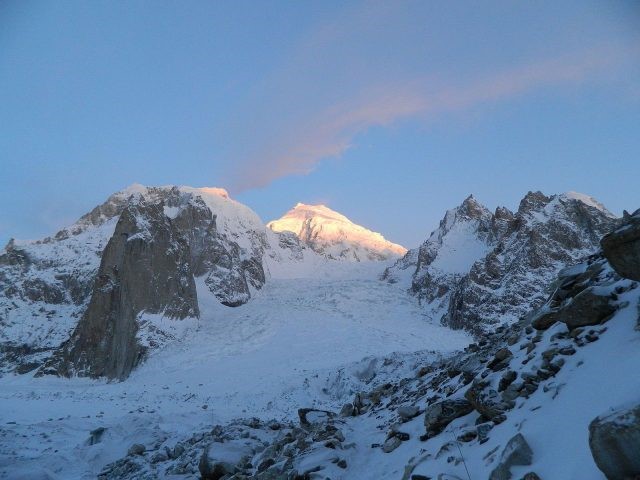
The Siachen Glacier is a glacier located in the eastern Karakoram range in the Himalayas. The Siachen glacier is often referred to as the world’s highest battlefield, where Indian and Pakistani troops have faced off since 1984. At 76 km long, it is the longest glacier in the Karakoram and second-longest in the world’s non-polar areas. It falls from an altitude of 5,753 m (18,875 ft) above sea level at its head at Indira Col on the China border down to 3,620 m (11,875 ft) at its terminus. Pakistan maintains a territorial claim over the Siachen Glacier and controls the region west of Saltoro Ridge, lying west of the glacier, with Pakistani posts located 3,000 ft below more than 100 Indian posts on the ridge.
Indian and Pakistani troops are deployed there and because of that trash is accumulated there. During all the years the trash has slowly built up, and lies in the crevasses of the glacier, and on its surface. Unfortunately, there are no mechanisms to remove it.
“Only soldiers return, if they are lucky, and their ammunition from Siachen. And also some dead bodies. Everything else remains there,” said Lobzang Stobzan, a senior porter who has recruited porters for Siachen since 1984 at Panamik, one of the last three villages near the Siachen Base Camp in the Karakorum Himalayas.
There is a box (incinerator) made by the army for burning the trash. Most of the waste generated at the base camp is burnt in that though a lot of waste still ends up going into the stream (Nubra or Siachen River, a tributary of the Indus) flowing near the base camp. But the waste generated at Siachen stays there only. The trash includes empty cardboard boxes, metal containers, juice cartons and jerry cans. It has been observed that where there are cardboard boxes, ice melts rapidly in those areas. It has been told by army officers that since cardboard boxes become black after absorbing moisture from ice, they trap more heat and cause fast melting. One can see heaps of jerry cans, which are emptied after the soldiers and porters use the kerosene in them, lying in the glacier, said Thukjay Lotus, another porter who has been going to the glacier for the past 25 years. Much of the waste goes deep into the crevasses, he said. At Siachen, the coldest combat zone in the world where temperatures can dip as low as minus 50 Celsius and annual snowfall can exceed 30 feet, kerosene is the only fuel which is used for cooking and making water from ice.
A soldier approximately consumes an average of 250 ml of kerosene every day. Going by that, a post where 15 soldiers are stationed will require 112.5 litres of kerosene in a month or 1,350 litres in a year. There are over 150 posts of the Indian army at Siachen, the porters said. If every post has an average of 15 men, it means the posts would consume 202,500 litres of kerosene in a year. Each jerry can contain 20 litres of kerosene which implies that 10,125 jerry cans are dumped into the Siachen glacier every year on the Indian side alone.
The quantity of garbage being thrown into the crevices in barrels is huge. If the crevices move and the barrels break, the amount of waste which will go into the river will be of such proportion that Pakistan will almost get drowned in waste.
According to the experts that visit Siachen, they say that the glacier in most areas has vanished. They think that it has melted because many people walk over it and stay there. They are of the view that filthy glacier melts faster. There is “too much” pollution in the glacier as there is no way porters or soldiers can carry the trash back.
Military experts and peace activists have consistently questioned the strategic and economic significance of the Siachen glacier, saying it does not justify the toll it exacts in men and money. The amount of money and resources being spent for occupying this glacier is mind-boggling. All this is being done at the cost of the environment.
by: Abeer Arshad




Leave a Reply
You must be logged in to post a comment.