
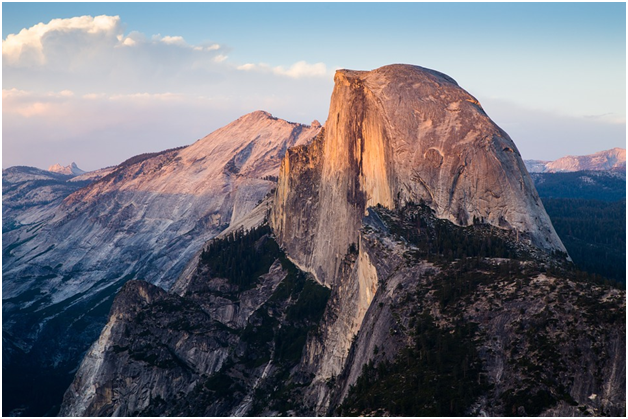
One of the most fascinating natural structures in Yosemite National Park in California is the granite outcropping called Half Dome. Standing 4,737 feet above the valley floor, it appears to be a round dome with the Northwest half missing when viewed from the valley. In profile, however, it can be seen that this rock formation is actually a ridge.
Half Dome was described as “perfectly inaccessible” by Josiah Whitney of the California Geological Survey as late as the 1870s. The eight-and-a-half mile hike from the valley floor is considered one of the most dangerous in the country, with 300 hikers a year needing to be rescued and six recorded deaths of climbers so far. Climbers typically camp at the base of the Northwest Face and start the climb fresh in the morning.
In September 2013, climbers Timmy O’Neill and Steve Baskis successfully completed the climb of Half Dome’s Northwest Face, a route that is nearly a mile high. They achieved this difficult feat using only their hands and feet, a technique known as ‘free climbing.’ The amazing part of this story is that both of them are wounded veterans. Even more amazing is that they reached the summit in one day.
O’Neill and Baskis made the climb with a team of fifteen Iraq and Afghanistan War veterans. One member of the team lost a leg and wears a prosthesis, which he removed and clipped to his belt
halfway up the slope. O’Neill is a professional climber and he led the team, coaching Baskis, who is blind.
The climb was made as commemoration of the lives lost on September 11, 2001, with the bombing of the World Trade Center. The veterans made the hike to the base of Half Dome and the ensuing climb as if they were participating in a combat patrol, a peacetime mission that was therapeutic to many of them.
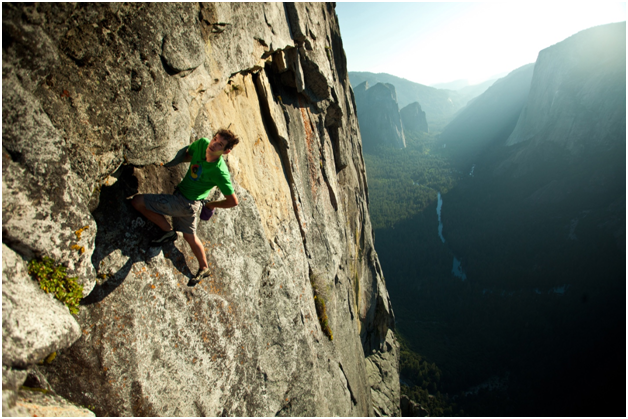
Although Alex Honnold was physically fit when he climbed the Northwest Face in 2008, he not only free climbed but did it without the aid of ropes. There is an easier route from the east that’s popular with tourists, and Honnold could hear them talking as he maneuvered past the most difficult part of the climb.
A twenty-six minute documentary was released in 2010 about Honnold’s ascent of Half Dome. ‘Alone on the Wall’ helped him attract corporate sponsors and build his career as a professional climber. He has become a celebrity in rock climbing circles because of his daring moves and seeming absence of fear during difficult climbs.
One major sponsor eventually withdrew funding, however. They weren’t happy with the risks Honnold takes when climbing, including balancing against a sheer rock face on nothing but the toe of his athletic shoe wedged into a shallow divot. Honnold vowed to continue climbing however,
writing in an Op Ed piece for the New York Times, “If I have a particular gift, it’s a mental one…the ability to keep it together where others might freak out.”
What motivates people like these to take great risks in free climbing without tools, using only hands and feet? For some, like Alex Honnold, the thrill of achievement comes into play. Certainly, now that he has made a career as a climber, it’s apparent to all that he has a great deal of innate ability. It takes a particular kind of person to complete the dangerous feats he manages. In interviews, Honnold has expressed a need to explore his talents to their fullest potential.
For veterans O’Neill and Baskis, the thrill of the challenge is certainly part of their motivation to climb. But they also have the reward of proving to themselves that they can perform outstanding physical feats despite their disabilities. The comradeship of fellow vets and their shared mission is also a healing experience after the trauma of serving in war.
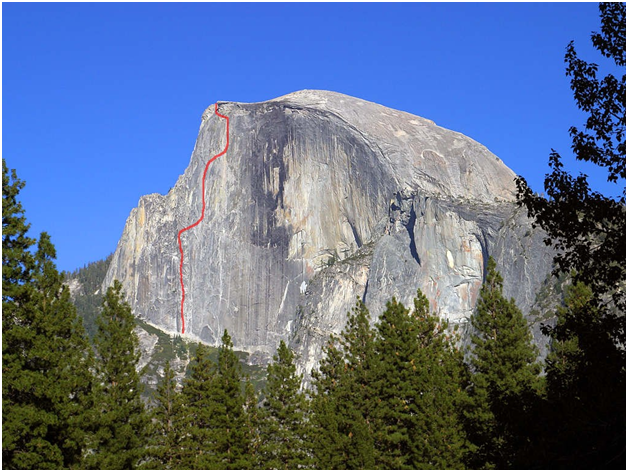
As of this July, scaling Half Dome has become harder for anyone, not just free climbers. Greg Stock, a Yosemite National Park geologist and climber, reported that a fairly easy section of the cliff face had been replaced with sheer rock. Small rock falls happen weekly in Yosemite, with larger ones occurring about once a year. This particular shearing off occurred during a violent thunderstorm.
Now that the climb of the Northwest slope of Half Dome has become much more difficult, Any one seriously considering the free climb might want to take a look at differenttypes of life insurances before doing so. A series of bolts has been added to Half Dome across the smooth scar that was left behind after the rock fall. This part of the route remains very steep, however, and some believe that Half Dome is now too dangerous to climb. Only time will tell whether everyone agrees with that opinion!
By: Vincent Stokes
Tags: Climbed Half Dome, Research Article, World




Leave a Reply
You must be logged in to post a comment.