
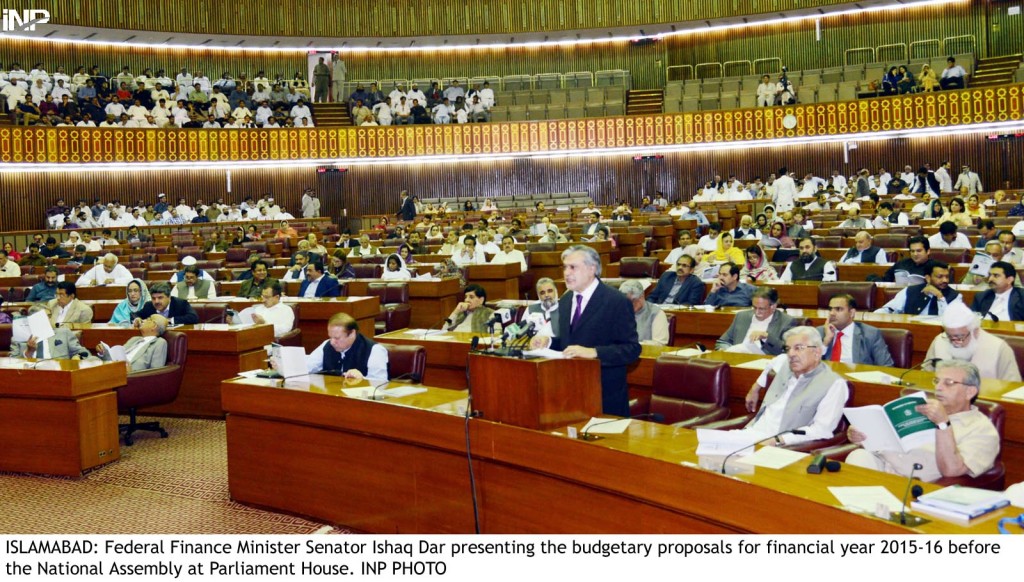
The federal government on Friday unveiled budget for the fiscal year 2015-16 with a total outlay of Rs 4.45 trillion, 3.5 percent more than the budget estimates of 2014-15, with the budget deficit standing at Rs 1.3 trillion and revenue target of Rs 3.1 trillion.
The federal cabinet gave a formal approval to the budget in its session held at the Parliament House ahead of the National Assembly session. Prime Minister Nawaz Sharif chaired the meeting which urged the federal government to increase the salaries of the federal government employees from proposed 5 percent to 7.5 per cent.
Addressing the meeting, the premier said sectoral contributions include 3.9 per cent in agriculture, 6.4 per cent in industry and 5.7 per cent in services. He said the current Five Year Plan 2013-18 is a comprehensive roadmap which sets timelines for achieving high growth rate. The outlook for 2015-16 is positive with a significant recovery in growth momentum, he added.
The resource availability during 2015-16 has been estimated at Rs 4.16 trillion against Rs 4 trillion in the budget estimates of 2014-15. The growth of Gross Domestic Product (GDP) for 2015-16 is targeted at 5.5 per cent and gradually it would be steered to over 7 per cent by 2018.
The net revenue receipts of 2015-16 have been estimated at Rs 2,463.4 billion, indicating an increase of 10.7 per cent from the budget estimates of 2014-15. The provincial share in federal taxes is estimated at 1,849.4 billion during 2015-16, which is 7.5 per cent higher than the last year’s budget estimates.
The net capital receipts for 2015-16 have been estimated Rs 606.3 billion, against the budget estimates of Rs.690.7 billion in 2014-15; a decline of 12.2 per cent. The external receipts in 2015-16 are estimated at Rs 751.5 billion; an increase of 12.2 per cent.
The current expenditure is Rs 3.48 trillion and development expenditure is Rs 969 billion. The share of current and development expenditure, respectively, in total budgetary outlay for 2015-16 is 78.2 per cent and 21.8 per cent.
The expenditure on general public service is estimated at Rs 2.44 trillion which is 70.3 per cent of the current expenditure. The other development expenditure outside PSDP for 2015-16 has been estimated at Rs 164.4 billion
It was the eighth budget presented by a civilian government following the dictatorial regime of General (r) Pervez Musharraf which ended in 2008.
Finance Minister Ishaq Dar presented the budget in an environment of total agreement and conformity as the opposition benches remained calm and offered no resistance to the finance minister.
“We have decided not to create any problems for Mr Dar. Rather, we will listen to the budget speech and then come up with positive and constructive criticism,” NA Opposition Leader Khurshid Shah told journalists before the budget session.
Delivering the budget speech during the NA session, Finance Minister Ishaq Dar said that the government aimed at boosting revenues by 9 per cent to $42 billion in 2015/16. Dar added that the government was going to achieve the 5 per cent target of fiscal deficit during the current year which would be brought down to 4.3 per cent by year 2017-18. He said that the reduction in fiscal deficit would continue to consolidate the gains with the target set at 4.3 per cent against 5 per cent in 2014-15.
He said energy generation was one of the government’s key priorities as it planned to add 7,000 megawatts (MW) to the system, besides setting up 3600 MW LNG-based projects. He said by December 2017, the government would be able to add 10,600 MW in the system.
“Beyond December 2017, other projects such as Dasu, Diamer-Bhasha dams, Karachi Civil Nuclear Energy project and many other projects will also be completed,” he added.
The minister said the government had proposed additional measures to boost exports and to ease the cost of doing business, besides improving an overall regulatory regime to facilitate exporters. He said the government was projecting the investment-to-GDP ratio to rise to 16.5 per cent during 2015-16.
Moreover, the minister added that the debt to GDP ratio would be brought down to less than 60 per cent in accordance with the provisions of Fiscal Responsibility and Debt Limitation (FRDL) Act, 2005.
“We are increasing the total amount for the Benazir Income Support Programme (BISP) to Rs 102 billion. Under the BISP, until 2012-13, the cash transfer programme was covering 4.1 million families. The number would be increased to 5 million during the current year and by end of next financial year it would rise to 5.3 million, showing an increase of 29 per cent since 2012-13,” he added.
Taunting the Pakistan People’s Party (PPP) lawmakers, Senator Dar asked the opposition benches to clap for the Pakistan Muslim League-Nawaz (PML-N) government which had done what their own government could not do.
He said a project for Universal E-telecasters with an investment of Rs 12 billion had been approved and in the first phase, 500 tele-centres would be established in all the provinces, including FATA.
The minister said for connectivity of remote area, the government had decided to invest Rs.2.8 billion for laying optic fibre optic cables. He said the government had rationalized the rates of international calls, which would benefit expatriate Pakistanis and promote legal traffic, which increased from 367 million minutes per month in November 2014 to 1,100 million minutes per month by now – a threefold increase.
The minister said as announced in the last budget, 500 IT scholarships with a total cost of Rs 125 million would be provided to the talented students from rural and non-metropolitan areas.
He said the GDP growth would gradually rise to 7 per cent by FY 2017-18, inflation would be contained to a single digit, investment-to-GDP ratio was set to rise to 20 per cent at the end of medium term, while fiscal deficit would be brought down to 3.5 per cent of the GDP.
The minister said tax-to-GDP ratio would be increased to 13 per cent and foreign exchange reserves would be maintained above $20 billion by the end of year 2017-18.
Senator Dar said that the government had earmarked Rs 1,513 billion for the National Development Programme during 2015-16, while the Public Sector Development Programme (PSDP) 2015-16 was Rs 700 billion strong. He said in the water sector, the government proposed to invest Rs 31 billion for projects in various parts of the country.
“A project that will be the future lifeline of Pakistan is the Diamir Bhasha Dam, which will store 4.7 MAF of water and generate electricity of 4500 MW. For this we have provided Rs 15 billion for land acquisition during the year,” he added.
The minister said for the energy sector, the government had taken a number of steps to address structural problems, including reduction in system losses, improvement in recoveries, elimination of theft and settlement of inter-corporate circular debt.
He said during the current year, a sum of Rs 248 billion would be invested in this sector, up from Rs 200 billion allocated in last year’s budget.
“Out of this amount, Rs 73 billion will come from the PSDP. The government is aiming to almost end load-shedding by December 2017,” he added.
The minister said that federal and Balochistan governments would jointly compensate for the damages of Mirani Dam victims, to the tune of Rs 3.5 billion. He said that in order to provide relief to the affected people, Prime Minister Nawaz Sharif has decided to compensate the damages.
Senator Dar said the government has proposed one per cent tax relief for the companies in budget for fiscal year 2015-16, bringing it down from current 33 per cent to 32 per cent. He said that the step was taken to promote and encourage corporate culture and documentation of the economic activities in the country.
He said that government had introduced a policy to reduce annual tax ratio of the companies by one percent and had reduced tax from 35 per cent to 30 per cent. He said that last year it was brought down to 33 per cent which has further been reduced by 1 per cent and set at 32 per cent which would encourage trade sector.
The minister said that government has also proposed income tax exemption on profit of electricity transmission lines projects for 10 years which was aimed at encouraging private sector to invest in power sector to overcome energy issues in the country.
Besides, he said that to encourage the saving and promote investment in the country, the government was providing tax credit on shares for listed company in stock exchange, its limit was increased from Rs 1 million to 1.5 million.
Dar said that government has also proposed to reduce advance income tax on token tax of vehicles from 20 per cent to 25 per cent adding that in order to increase the operation of small companies in the country, capital for small companies was also increased from Rs 25 million to 50 million.
In budget 2015-16, the government has also proposed relief for small tax payers and salaried class.
In order to provide relief for salaried class whose taxable income was 400,000 to 500,000, the government has proposed to reduce tax ratio from 5 per cent to 2 per cent.
He said that an amount of Rs 175 billion has been earmarked for the five special programmes in PSDP 2015-16.
At a point of order, NA opposition leader Syed Khurshid Shah expressed his concerns over the minimal 7.5 percent raise in the salaries of the government employees, arguing that the finance minister throughout his speech had painted a “rosy picture” about the economic gains of the government but when it came to the raise in salaries of the government servants, the minister tried to portray a negative picture which reflected that the government had “no feelings for the poor”.
National Assembly Speaker Ayaz Sadiq, however, disapproved remarks made by Shah, saying that no comments could be made on the budget before opening a formal debate over the subject. The House was adjourned to meet again on Monday.
source:pakistantoday
Tags: fiscal budget, Minister Nawaz Sharif, pakistan budget, year 2015-16




Leave a Reply
You must be logged in to post a comment.