
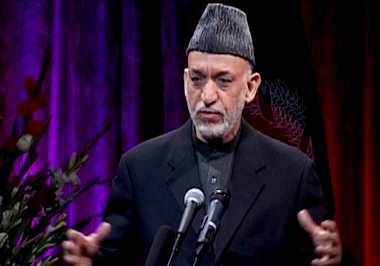
President Hamid Karzai on Tuesday said that the state of press freedom and independent media would continue to progress in Afghanistan under the new political leadership voted into office in April, while also calling on media outlets to use their voices to support national interests.
While inaugurating the new Bayat Media Center in Kabul on Tuesday, President Karzai reaffirmed his commitment to freedom of the press, and his confidence that his successor would honor the cause in the future.
“I am fully confident that freedom of speech will move forward; television, journalists and writers will continue working, and the next government is obliged to move on the same track, Inshallah, this track is irreversible,” Karzai said.
President Karzai urged media to strengthen national unification amongst the Afghan people and support the country.
“We must note in what manner our media outlets really act as our history will remember which media outlets used freedom of expression for what purposes,” Karzai added in a cautionary tone.
Afghan media has grown in leaps and bounds in the 13 years since the Taliban regime was ousted by the U.S.-led invasion, yet many media professionals and activists remain critical of the government at times for its attitude toward the industry.
In 2013, media advocates spoke out against the creation of the Media Complaints Commission (MCC), headed by the Minister of Information and Culture, which they believe could serve as a body to censor media unfavorable to powerful figures in government.
Violence against journalists was also a hot-button issue in the past year, and remains one that activists around the country are concerned about, especially heading into the April elections at which time media coverage around the country will reach a fever pitch.
Some have also argued that political leaders in Kabul expect journalists to serve as de facto publicists, promoting the good of the Western-backed regime and remaining hushed on issues like corruption and other forms of malfeasance. Media activists argue this kind of press freedom challenges their true independence.
But, ultimately, whether or not exposing improprieties in government or bolstering confidence is what the media should be doing may come down to differing interpretations of what exactly the country’s “national interests” are.
Currently, along with some government outlets, 69 television networks, 157 radio stations and more than a hundred print publications are active in Afghanistan.
Tolonews




Leave a Reply
You must be logged in to post a comment.