
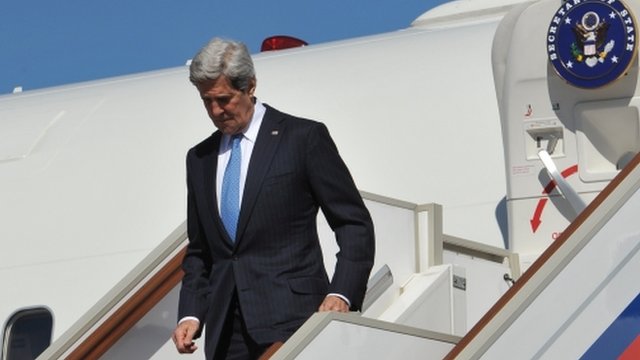
US Secretary of State John Kerry has held talks with Russian President Vladimir Putin in Moscow to try to bridge the divide between the two sides over the Syria conflict.
Before the talks, Mr Kerry said Russia and the US shared common interests in promoting stability in the region.
Moscow, which supports Syrian leader Bashar al-Assad, is refusing to back US pressure to force him to step down.
The US recently said it did not rule out arming the Syrian opposition.
“Arming the rebels – that’s an option,” US Defence Secretary, Chuck Hagel said last week.
Mr Kerry’s visit comes days after Israel launched air strikes in southern Syria.
Russia condemned the attacks – which Israeli sources said targeted missiles destined for Hezbollah in Lebanon – as a threat to regional stability.
President Putin had spoken to Israeli Prime Minister Benjamin Netanyahu, the Kremlin said.
Chemical weapons
 Steve RosenbergBBC News, Moscow
The US has tried and failed many times before to get Russia to change its position on Syria. So will John Kerry be able to convince Moscow that now is the time to get tougher with President Assad?
Convincing the Kremlin leader will not be easy. Not only because Russia has been a staunch ally of the Syrian leadership. Moscow genuinely fears that a bad situation could be made even worse if Assad is forced from power and worries that Islamic extremists may fill the void.
The signs are that Moscow will not be swayed by Western claims that chemical weapons have been used in Syria. This week, the Russian foreign ministry called on the West to stop politicising the issue of chemical weapons. It expressed concern that world public opinion was being prepared for possible military intervention in the Syrian conflict.
In recent months, US-Russian relations have grown decidedly frosty; some of the rhetoric emerging from Washington and Moscow has been reminiscent of the Cold War. That will not help John Kerry persuade the Kremlin to see things America’s way.
And yet there are signs that both countries are keen to improve ties and boost cooperation – for example in the area of counter-terrorism. In Moscow last month, President Obama’s national security advisor delivered a letter from Obama to Putin about improving relations. If a new detente results, that could help the US and Russia find common ground on the Syrian conflict, too.
Ahead of Mr Kerry’s visit, Russia’s foreign ministry called on the West to stop politicising the issue of chemical weapons in Syria, BBC Moscow correspondent Steven Rosenberg reports.
It expressed concern that world public opinion was being prepared for possible military intervention, he adds.
The UN has played down claims by one of its experts that there was evidence rebels had used nerve gas.
Investigator Carla Del Ponte earlier said testimony from victims and doctors had given rise to “strong, concrete suspicions but not yet incontrovertible proof” that opposition forces had used sarin.
But the Commission of Inquiry on Syria stressed on Monday it had not reached any “conclusive findings”.
Sarin, an extremely potent chemical nerve agent, is colourless and odourless. The use of chemical weapons is banned by most countries.
In Washington, White House spokesman Jay Carney said it was “highly likely” that any use of chemical weapons that had taken place had been carried out by government forces.
Both the US and Israel have described the use of chemical weapons in the Syrian conflict as a “game-changer”, which could trigger international military intervention.
Sources:www.bbcnews.co.uk/news




Leave a Reply
You must be logged in to post a comment.