
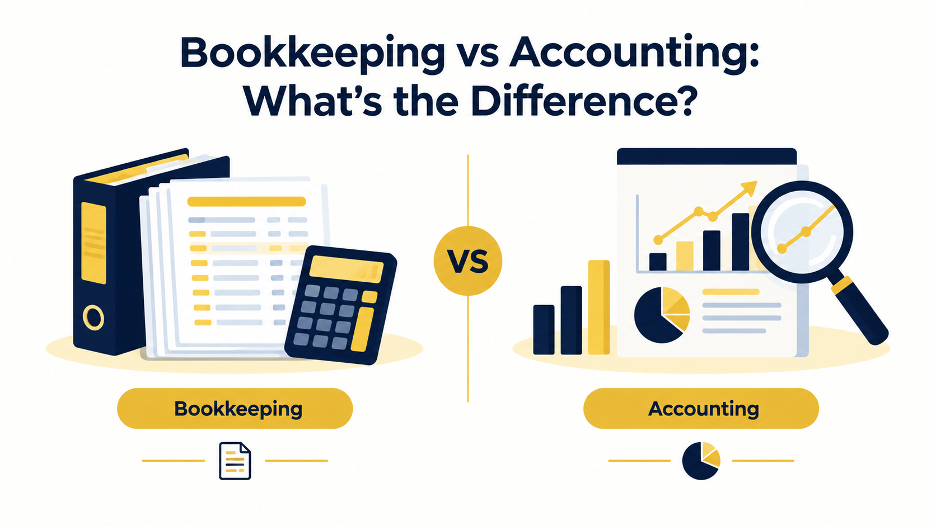
When it comes to accounting vs. bookkeeping, the biggest difference is in their scope and depth. Bookkeeping handles the day-to-day financial records, including recording transactions, reconciling accounts, and keeping ledgers accurate. Accounting takes those records a step further with financial statements, tax planning, and compliance.
So, what does your business actually need? This guide breaks down the key bookkeeping vs. accounting difference, where the two overlap, and when to hire a bookkeeper, an accountant, or both.
Bookkeeping is the day-to-day process of recording and organizing a business’s financial transactions to ensure your books remain accurate, complete, and up to date.
Accounting takes the raw transaction data from bookkeeping and turns it into financial statements, tax filings, and insights that help you make better business decisions.
In short, professional bookkeeping services help you track what happened financially, while accounting analyzes why it happened and advises you on what to do next.
Accounting can be of two types:
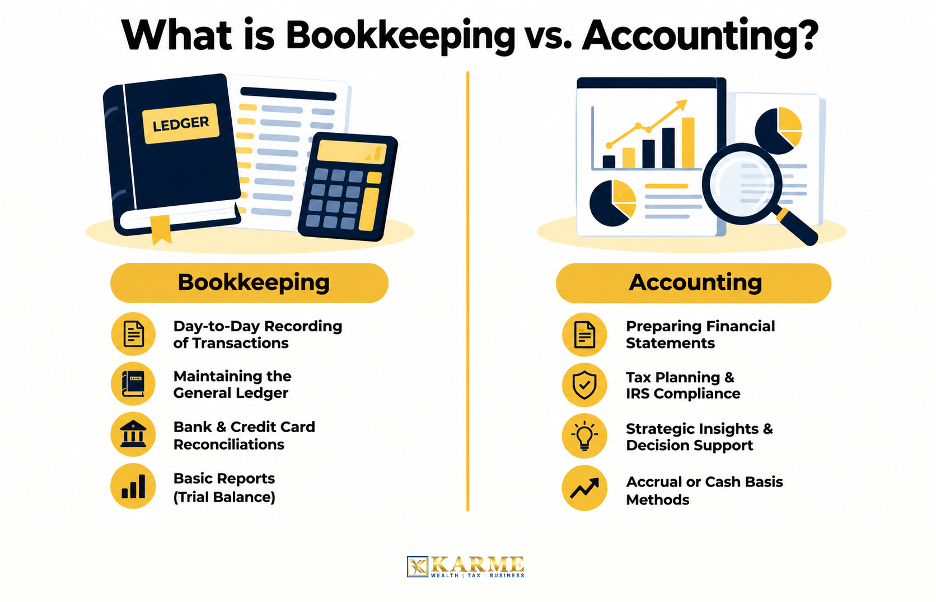
Now, let’s look at the core responsibilities of both bookkeeping and accounting.
A bookkeeper typically handles tasks such as:
To stay on top of these tasks, many small businesses also keep a monthly bookkeeping checklist to keep their financial records organized and tax-ready throughout the year.
Accounting involves much more than reviewing numbers. Key tasks include:
If your business needs help with these tasks, working with an external accounting services team gives you access to expertise without the cost of hiring an in-house accountant. You can get help with tax preparation, tax planning, financial reporting, and IRS compliance throughout the year.
The main difference between bookkeeping and accounting is that bookkeeping records financial activity, while accounting interprets it. The rest comes down to how each role uses that financial information.
Here are the specific differences.
Bookkeepers record income, expenses, payments, and other financial activity. They also reconcile accounts and maintain organized ledgers that show what happened.
Accounting uses those records to analyze the numbers and turn them into financial statements, tax positions, and reports to support financial decisions.
Bookkeeping does not require a four-year degree. Many bookkeepers have a high school diploma or associate degree, along with a solid understanding of debits and credits and accounting software such as QuickBooks or Xero. Certifications such as Certified Bookkeeper (CB) are optional.
Accounting requires more formal education and training. Accountants need at least a bachelor’s degree. Professional credentials such as CPA, CA, or ACCA also require rigorous exams and, depending on the credential, relevant professional experience.
Bookkeeping happens continuously. Transactions are recorded, and accounts are updated day by day. Accounting works on a broader schedule. Accountants review financial results monthly, quarterly, or annually.
The pay and job outlook also differ. According to the U.S. Bureau of Labor Statistics, bookkeeping, accounting, and auditing clerks earned a median annual wage of $50,670 in May 2025. Employment for these roles is projected to decline about 6% from 2025 to 2035, partly because software can automate many routine tasks.
Meanwhile, accountants and auditors earned a median annual wage of $83,680 in May 2025. Employment is projected to grow 5% from 2025 to 2035, which is faster than the average for all occupations.
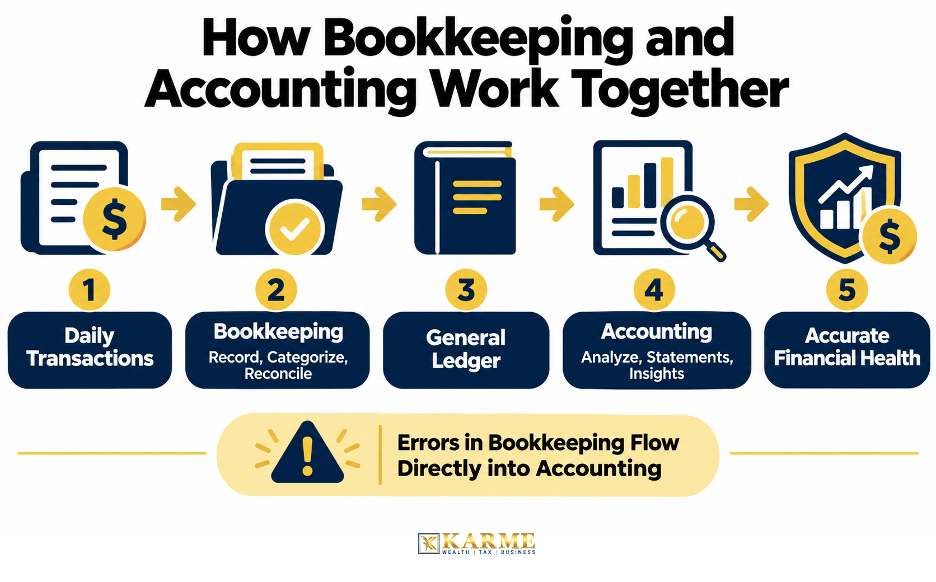
Bookkeeping and accounting work hand in hand. Bookkeepers record, categorize, and reconcile all transactions before posting them to the general ledger. From there, an accountant uses the organized data to prepare financial statements and assess the business’s financial position.
This means that errors at the bookkeeping stage carry straight through to accounting. For example, a payroll error can affect cash flow and throw off account reconciliations. Those errors can then distort the financial statements based on that data. When both functions work together, businesses get a clear and accurate view of their financial health.
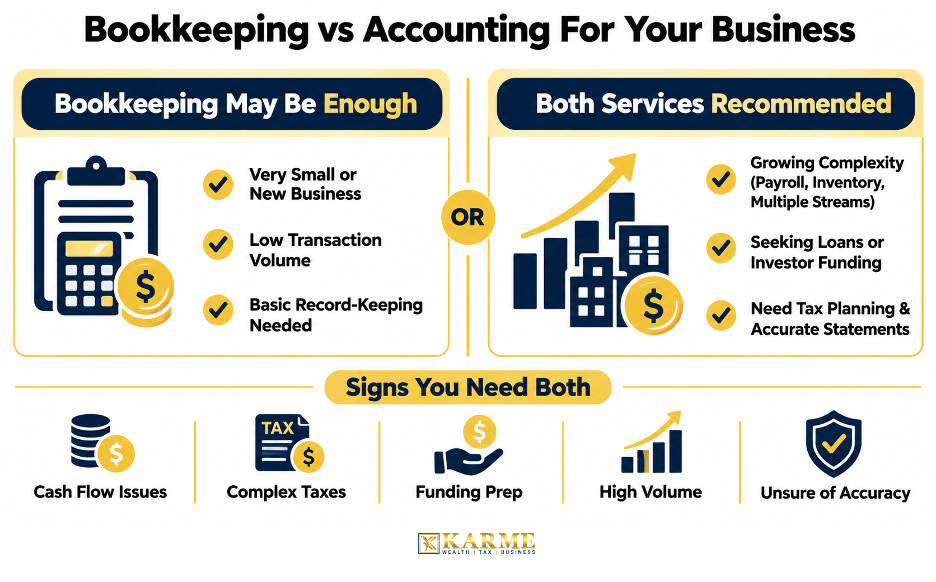
Choosing between bookkeeping vs. accounting for small businesses comes down to your business size, transaction volume, and the level of financial guidance you need.
If you run a very small or new business, such as a solo consulting practice with only a few monthly transactions, consistent bookkeeping may be enough. But as your business grows, things can get more complicated. Payroll, inventory, multiple revenue streams, or investor and lender reporting may call for professional accounting oversight.
If you’re unsure why your business needs a professional bookkeeper or accountant, look for these signs:
Q1. Can a bookkeeper prepare financial statements for my business?
No. A bookkeeper can prepare a trial balance and basic financial reports. But formal financial statements, such as an income statement or balance sheet, require an accountant to review, analyze, and interpret the numbers.
Q2. Do bookkeepers need a license or certification to work legally?
No. Bookkeepers do not need a license to work, unlike CPAs. Certifications such as Certified Bookkeeper or Certified Public Bookkeeper are available, but they are optional.
Q3. What is accrual vs. cash basis accounting?
Accrual-basis accounting records income when it is earned and expenses when they are incurred, even if payment happens later. Cash-basis accounting records revenue and expenses only when you receive or pay the money.
Q4. What happens if a business only keeps books and skips accounting?
Your books may stay up to date, but you could miss important financial analysis, tax planning, and compliance checks. That can leave costly errors hidden until tax time.
Q5. Can accounting software fully replace a bookkeeper or accountant?
No. Accounting software can automate data entry and generate basic reports, but it cannot replace the human judgment needed to catch unusual transactions, find errors, and provide financial guidance.
Q6. How much time should a small business owner spend on bookkeeping personally?
A small business owner can spend about 1 to 3 hours per week to personally handle bookkeeping. But the actual time depends highly on transaction volume and how complex your finances are.
In short, understanding bookkeeping vs. accounting comes down to this: bookkeeping records the numbers, while accounting interprets them. Both keep your business accurate, compliant, and ready to grow. Getting that balance right on your own is hard, which is why professional support matters.
At Karme, we combine QuickBooks-driven bookkeeping with full accounting services. You get tax-ready financial statements, payroll support, and IRS compliance, all through secure, cloud-based tools. Whether you’re in Texas or beyond, we’re here to help you keep your finances on track. Get in touch today.
by: Riley Marsh




Leave a Reply
You must be logged in to post a comment.