
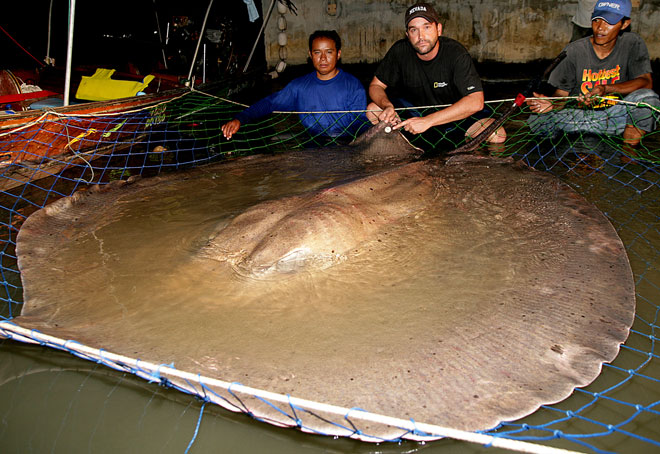
Scientists working in Thailand’s Mae Klong River made a big find last week: an enormous stingray that they think is a contender for the largest freshwater fish ever documented by researchers.
The ray was caught and released in about 65 feet (20 meters) of water in the Amphawa District, about an hour outside Bangkok.
Nantarika Chansue, a veterinarian and professor at Chulalongkorn University in Bangkok, helped catch and measure what she calls the “big one.” The ray (Himantura polylepis or H. chaophraya) was 7.9 feet (2.4 meters) across and 14 feet (4.3 meters) long and weighed an estimated 700 to 800 pounds (318 to 363 kilograms), she said via e-mail.
The team was unable to get an exact weight because “it’s really hard to weigh these things without hurting them, because they are such big, awkward animals,” says Zeb Hogan, a National Geographic fellow and a professor of biology at the University of Nevada, Reno.
“Certainly [this] was a huge fish, even compared to other giant freshwater stingrays, and definitely ranks among the largest freshwater fish in the world,” he says.
Hogan has a connection to this particular ray: The same animal was caught and tagged in 2009 under a program he runs with Nantarika. (Learn about a colossal, 280-pound catfish.)
Nantarika performed a portable ultrasound on the ray while it was held in a cage in the river, revealing that the animal was pregnant with two fetal rays. Records show that she was also pregnant when caught in 2009.
“That indicates it was found in an area that is likely a nursery ground,” Hogan says.
In 2009, the ray was 6.5 feet (2 meters) across and 15 feet (4.58 meters) long. “Her tail might have been shortened by some accident,” says Nantarika. The ray also had bite marks that may have come from a male ray.
By knowing how much time had elapsed since the ray was last studied, scientists now have a better idea about how fast rays can grow. Like most fish, they keep growing as long as they live and can find enough food. Giant stingrays are bottom feeders, preying on fish, prawns, mussels, clams, and whatever else they can find. Scientists don’t know how long the rays can live, but Nantarika estimates this one is between 35 and 40 years old, based on its size… see more
source: national geographic news




Leave a Reply
You must be logged in to post a comment.