
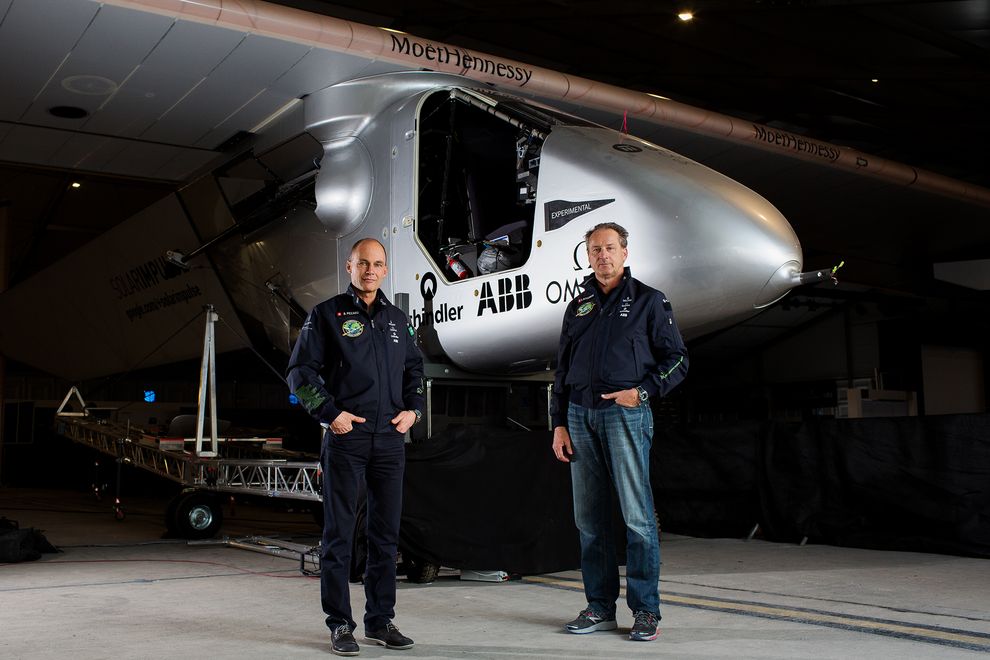
ABU DHABI, United Arab Emirates—Early on Monday, if the desert wind rushing toward the Strait of Hormuz lays down and dawn comes in clear and bright, a very large and odd-looking experimental aircraft will lift off from a military airport in Abu Dhabi, turn east toward the rising sun, and take a run at history.
On board will be a single pilot, for the cockpit is too small, and too cramped, to carry more. He will steer through morning quietly and quite slowly—faster than a running man, but far slower than, say, a Vespa scooter driven by a guy who’s late for work.
From below, his aircraft will resemble a toy, with enormous, stiff wings jutting out of a short, thin fuselage, and stabilizers at the tail that are as blunt as pegs on a pogo stick.
As the plane begins to climb, almost imperceptibly, the impression will be of an object set adrift more than one purposefully driven. By contrast, almost any aircraft it meets, even certain thumb-toggled drones, will seem like overachievers.
With altitude, however, the plane comes into its own. Seen from above, in thin, calm air, its lines suggest an albatross or a condor, strong of shoulder, built for distance. And the reasons for the craft’s oddity become clearer, too: Nearly every sun-facing surface, from wingtips to rudder, gleams with blue-black photovoltaic cells. The plane is called the Solar Impulse 2, and the Swiss explorers who built it, Bertrand Piccard and André Borschberg, intend to be the first to fly around the world propelled only by the power of light.
Heading first to India, next to China, and then on to the United States, their journey will last some five months, with many stops along the way. During the longest legs of their flight, over the Pacific and Atlantic Oceans, the men will remain in the air for days, beyond reach of runways, islands, or easy rescue. They will face dangerous, unpredictable weather over wide-open water, same as a host of earlier adventurers, many of whom never returned… see more
source: national geographic news
Tags: 'Fly Forever', Science, Swiss Adventurer Launches Quest


Leave a Reply
You must be logged in to post a comment.