
GAZIANTEP, TURKEY // The UN chief Ban Ki-moon and Russian president Vladimir Putin discussed the growing crisis in Syria yesterday, amid increasing concerns over Moscow supplying advanced weapons – including supersonic cruise missiles – to President Bashar Al Assad.
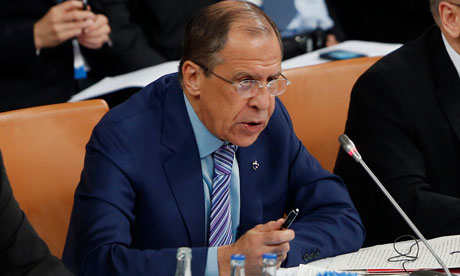
The Russian foreign minister, Sergei Lavrov, who met the UN secretary general earlier in the day, said he was baffled by continued interest in Moscow’s arms deals with the Syrian regime.
“I do not understand why the media is trying to create a sensation out of this,” Mr Lavrov said.
“We have not hidden that we supply weapons to Syria under signed contracts, without violating any international agreements, or our own legislation.
“We are first and foremost supplying defence weapons related to air defence.”
On Thursday, unidentified US officials were quoted by The New York Times as saying Russia had recently sent advanced anti-ship missiles to Damascus, capable of sinking vessels nearly 300 kilometres away.
Russia has also remained somewhat enigmatic about supplies of the much-vaunted S-300 anti-aircraft missile system to Syria.
This month, when asked if Moscow would give the S-300 to Damascus, Mr Lavrov said Russia was not thinking of selling, but had already concluded a sale.
“Russia is not planning to sell. Russia already sold them a long time ago, he said last Friday. “It has signed the contracts and is completing deliveries, in line with the agreed contracts, of equipment which is anti-aircraft technology.”
But he did not specify if that deal related to the S-300 or another less advanced system.
Israeli officials have been cited in media reports this month as saying Damascus made payments towards four S-300 batteries and 144 missiles. In an effort to block any sale, the Israeli prime minister Benjamin Netanyahu met Mr Putin in Russia on Tuesday. No public announcement relating to weapons was made after the meeting by either leader.
Israel has carried out a series of airstrikes inside Syria, all apparently designed to stop weapons falling into the hands of Hizbollah, the Lebanese militant group that has been fighting alongside Mr Al Assad’s forces. Israeli jets would find it more difficult to stage such attacks if Syrian air defences were bolstered.
S-300s would also add to the problems of enforcing a no fly zone over Syria, the prospect of which was raised by Turkish prime minister Recip Tayyip Erdogan yesterday, despite Western states showing no intention of wanting to putting one in place .
“It is not a decision that could be taken between the United States and Turkey. It is something that would have to come through the U.N. Security Council,” Mr Erdogan said.
He also backed Beijing and Moscow being involved in planned peace talks.
Russia, a key ally to the Syrian regime and its principal weapons supplier, has been at the centre of a recent flurry of diplomatic activity. The American secretary of state John Kerry and British prime minister David Cameron have also held meetings with senior Russian officials this month.
The US-Russian talks resulted in an agreement to hold a peace conference involving the Syrian opposition and regime, although no date has yet been set.
Mr Ban’s talks with Mr Lavrov and Mr Putin in the Black Sea resort of Sochi yesterday were part of an effort to ensure that the conference happens quickly. The proposed negotiations have been dubbed “Geneva 2” because they are to be held in the Swiss city and represent a follow-up to a stillborn deal brokered by the then UN-special envoy to Syria, Kofi Annan, last June in the same location.
That vaguely worded agreement collapsed immediately over differing interpretations as to what it actually meant. The US, a backer of anti-regime factions, said the agreement made it clear Mr Al Assad would have to step down, while Russia and Damascus insisted it contained no such requirement.
source: http://www.thenational.ae
Tags: advanced weapons, Gaziantep, President Bashar Al Assad., Turkey, UN chief Ban Ki-moon




Leave a Reply
You must be logged in to post a comment.