
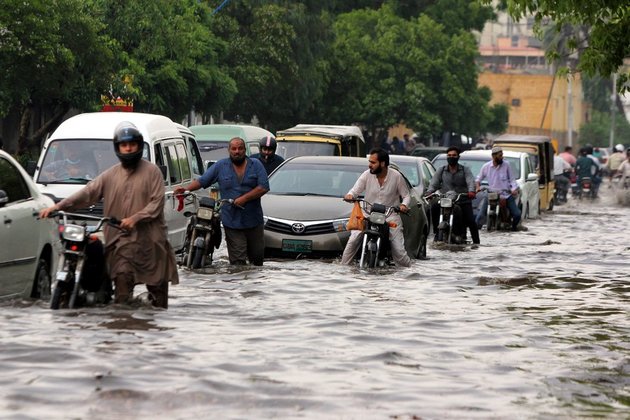
It has been reported by National Disaster Management Authority (NDMA) that the death toll in torrential rains that had been lashing Pakistan in separate spells since June, has risen to 134. They shared the data of casualties from June 15 to Aug. 29 on their website. The authority said on Saturday that rescue and relief operations are being carried out in the affected areas by concerned departments of the government, army and non-governmental organizations.
Chief Minister of Sindh Syed Murad Ali Shah told a press conference on Friday that 80 people were killed in rains in the province with 47 fatalities in provincial capital Karachi alone. He said 604-mm rainfall was recorded in Karachi during August, breaking years-long record of heavy rains in the city during the month.
These rains caused a devastating situation in southwest Balochistan and Khyber Pakhtunkhwa provinces where many people were left homeless after their houses were swept away by flash floods triggered off by heavy downpour. This year, the meteorological department forecast more than usual rains during the ongoing season, and concerned departments have issued advisories for the general public to take self-precautionary measures.
As if the damages caused by these torrential rains were not enough, health experts have predicted the outbreak of infectious diseases in Karachi particularly. The filthy drainage water that entered in residential area can be a breeding place for various disease causing microbes. Residents have also complained that sewerage water got mixed in their drinking water tanks and it is very well known that contaminated drinking water spreads diseases like hepatitis, malaria, typhoid, dengue, cholera etc. Health experts have urged the Sindh government to clean garbage and accumulated rainwater from the roads on a priority basis after the recent monsoon spell, pointing out that these could lead to an outbreak of infectious and water-borne diseases. Rain water from various areas of Karachi has still not been drained out despite passage of several days.
Vice-chancellor of Jinnah Sindh Medical University Dr Tariq Rafi told the media that that stagnant rainwater standing in different parts of Karachi could result in the spread of numerous diseases. “The larvae of mosquitoes will begin growing in the stagnant water. The monsoon is the best season for their reproduction.” Meanwhile, Infection Control Society Pakistan president Prof Rafiq Khanani said that bacteria would spread promptly in the garbage present across the city after the rain, which may become airborne. “The city is already dealing with Covid-19, but medical waste overflowing from the drains will also cause spread of virus.” Khanani also expressed fear of a surge in cases of throat infections and nasal allergies in this weather.
On the other hand, the Metrological department has predicted more rains in Karachi, Thatta, Hyderabad and Badin. The new spell is likely to continue for three days in Sindh and Balochistan. It is feared that the downpours will cause urban flooding and submerging of low-lying areas of lower Sindh. It is high time government and other concerned authorities should take immediate actions to deal with rain water. Clogged drains should be cleared before the next spell of rain otherwise there will be a havoc in the form of infection diseases just like it occurred in 2011, where 200,000 people suffered from infectious diseases in Sindh.
by: Abeer Arshad




Leave a Reply
You must be logged in to post a comment.