
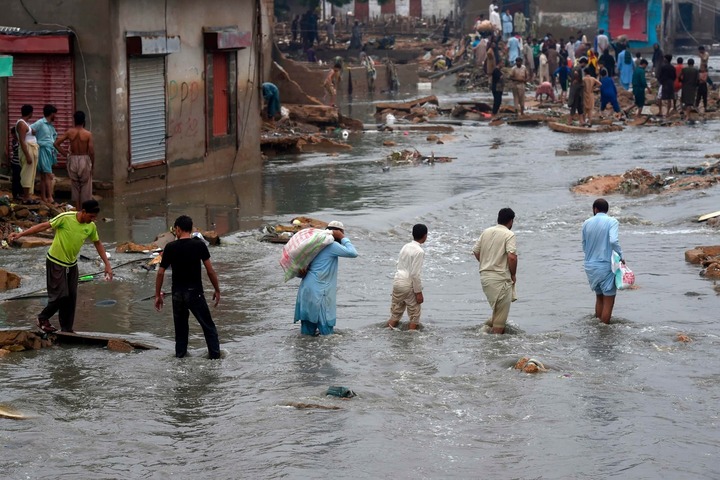
Residents of different districts in Sindh, including Karachi, Hyderabad, Thatta, Badin and Tharparkar experienced another destructive spell of monsoon rains. They suffered yet another prolonged period of power outages and inundated roads as heavy rainfall lashed southern Pakistan, with the provincial government consequently announcing an emergency. Sindh government spokesperson Senator Murtaza Wahab announced that Chief Minister Murad Ali Shah had declared emergency in Sindh after urban flooding was caused by heaving rains in Karachi.
Like every year in the monsoon season, Karachi faced spells of devastating urban flooding that caused a complete collapse of urban life. This time, Karachi experienced torrential rain as per the Pakistan Meteorological Department’s (PMD) prediction. Flooding because of recent rains, particularly on August 24, 25 proved to be much more catastrophic mostly in Karachi. Several roads, streets, and homes were flooded with rainwater. People were stuck on roads during rain and in many parts of the city people and cattle suffered electric shocks. Residents of the low-lying areas suffered property damage amounting to millions of rupees following hours of heavy downpour. A few days after the devastation caused by rains in the second spell, Prime Minister Imran Khan had directed the National Disaster Management Authority (NDMA) to start the clean-up in Karachi. The agency begins its action on August 3rd with the help of army and started clearing the city’s drains. However, this is a short-term fix amidst a blame game between political parties.
The Pakistan Peoples Party which is incharge of Sindh government, the Muttahida Qaumi Movement-Pakistan which has the Mayorship of Karachi and Pakistan Tehreek-i-Insaf which has the federal government, continue to blame one another over Karachi’s issues.
Mayor Waseem Akhter cries over the lack of funds and his limited powers and the Sindh government’s non-cooperation, saying that he is a powerless mayor of the metropolis where there are many other decision-makers. Many provincial lawmakers faced backlash for posting images of selected main roads, including Shahrah-e-Faisal, lauding the Sindh government for clearing it from rainwater within a few hours. Residents became furious and said that provincial government is trying to misrepresent the condition of the metropolis as several low-lying densely populated residential areas were actually submerged in rainwater.
The Karachi Mayor is responsible for 41 major stormwater drains while 500 minor drains fall under the six District Municipal Corporations in the city. On the other hand, the responsibility also lies with the Karachi Water and Sewerage Board and Sindh Solid Waste Management Board, two bodies operated under the Sindh government that have failed in their responsibilities to clean the drains and remove and dispose of the garbage and solid waste. In the beginning, the PPP leadership was angry over the federal government’s decision to send NDMA to ‘clean’ Karachi, calling it a conspiracy against its provincial government. Although, lately, the provincial government appreciated the measures taken by the NDMA and assured its cooperation.
The city has been facing this tripartite conflict for so long without any solution in sight. Coordinated decision and strict monitoring of corruption from lower to higher levels is necessary to prevent such disasters in future. Furthermore, it is note-worthy that climate change increases the frequency and intensity of floods, greater investment will be required in the years to come. Increased financing will be required for major infrastructure, reforms and institutional strengthening, urban services, flood mitigation, monitoring, early warning systems, and environmental management.
by: Abeer Arshad




Leave a Reply
You must be logged in to post a comment.