

The basic food printing concept was first presented in the movie Star Trek: The original series. It showed a machine through which users can make food according to their personalized requirements. 3D printing is a technology in which computer-aided design (CAD) software instructs digital fabricating machine to make 3D objects by continuous addition of successive layers. It uses wide number of Additive Manufacturing technologies (AM) such as Fused Deposition Model (FDM), Selective Laser Sintering (SLS), micro extrusion, laser assisted bioprinting etc. In the past 10 years, 3D printing is experimented in several areas such as art, science, medicine, food processing and engineering.
3D food printing is an integration of 3D printing and digital printing to provide customized sensoric quality with nutrition. Food Layer Manufacturing known as 3D food printing is a combination of traditional cooking integrated with additive manufacturing (AM) resulting in new foods which have complex structure and is difficult to make by hand as well as with the desired nutritional composition.
As per the fabrication principle, there are many 3D printing techniques in food industry. The techniques are grouped according to the following parameters: liquid, powder, or cell cultures. For printing meat, cell culture-based system is used.
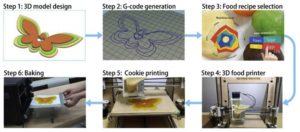
Extrusion is a process in which liquid/semi-solid/solid materials are pushed through a die opening to create objects with required cross sections. This process is digitally controlled and robotically constructed to build complex 3D foods by layering. It begins with loading then pushing of material out of nozzle in a controlled environment after which the material streams as per a predetermined path. Bonding takes place between deposited layers to form a solid structure. This type of food printer is compact, requires low maintenance but the drawback is limited material choices and a long fabrication time.
Soft material extrusion prints 3D food by mixing and depositing self-supporting layers of following materials: dough, meat paste and processed cheese. The viscosity of material should be low to a level that allow easy extrusion through fine nozzle, and it should be placed high to support the structure after deposition. Certain rheological additive or modifiers can be used to achieve required rheology, but it should comply with food safety standards.
Melting extrusion has been used for 3D printing of chocolates, there must be a temperature from 28-40 degrees Celsius for such products.
Hydrogel forming extrusion depends on polymer rheological properties as well as its gel forming mechanism or capacity. It was used as an alternative to print food material containing protein, starch etc.
Schematic diagram of extrusion-based 3D food printing process (Image source: https://onlinelibrary.wiley.com/cms/asset/18908152-6cc7-452a-afe4-8bb90f320046/jfpe13996-fig-0005-m.jpg)
Inkjet Printing (IJP) technology depends on the collection of droplets of material deposited by inkjet printing nozzles. Inkjet printer functions by using thermal or piezoelectric heads.
It is second most popular system after extrusion in 3D food printing. This category includes Selective Laser Sintering (SLS), Selective hot air sintering and melting (SHASAM) and Liquid binding (LB); which works with powder deposition in bed. On application of heat, infrared rays, or hot air by using SLS and SHASHAM the powder layers fuse with each other. The Liquid Binding method or technique has been patented as (3DP) that is 3D printing.
Bio-printing has been initially used to build tissues by excluding any type of biomaterial-based scaffold. It is a process where biological materials and cultures of living cells are deposited by layering on one another. The technologies used for such deposition are inkjet, layer assisted printing and micro extrusion.
The key issues related to the new technology of 3D food printing are:
Normal food printers with the functionality of printing 3D food and specialized food printers are available in the retail market. A better food fabrication can be achieved through specialized food printers, but it is very costly. The discounted price for Choc Creator V2.0 Plus is about 3,100 USD in the market, and for Foodini the retail price is around $1000.
There are many concerns regarding the food safety and labelling of 3D-printed food machines used in industries and in kitchens. GMO food also faced the same issues as long-term effects for consuming these novel foods are not known. This new technology could be the future if it is declared safe and provide tasty food alternatives.
There are limited ingredients which can be printed through 3D food. Furthermore, wide range of ingredients are required to print food which includes processed cheese, sauce, dough, sugars, carbs and proteins. Due to different chemical and physical nature of ingredients it is difficult to put all of these in one container. So, it is better to prepare ingredients at the time of making a food product. The printability of food is determined by the physical and chemical properties of different ingredients.
According to researchers and activists it is believed that 3D food printing can contribute positively to environment, sustainability, and nutritional behaviour. As world population is increasing, there is also an increasing demand for food. Alternative food sources can be used to combat this issue. In future, food ingredients extracted from fungi, algae, insects, seaweed and from agricultural and food waste can be used as printing materials in 3D food printing which can meet future food demand more sustainably and in an environmentally friendly way. Food fabrication combined with 3D food printing can make food which is good in taste and visually appealing for consumers.
The material properties and binding mechanisms is very important for the design of a 3D food which works with AM technology. There are many obstacles to overcome in order to use 3D food printing in a fabrication process. The two main challenges are: Productivity of the process and the functionality and innovation of the product. Mostly, 3D food printing technology is used to make complex geometrical structures but not for printing food with better nutritional value. To combine novel food structures with nutritional value, it is important to find correlations between the material properties and factors influencing normal food design.
3D food printing could influence significantly on the food processing industry. Through this technology, high quality food products can be prepared freshly and with personalized nutrition. Food printing can be used to make products with alternative ingredients like insects, algae and fungi which will contribute to sustainability. It also helps to reduce food waste and malnutrition. There are many barriers to accept 3D printed food by consumers. Main reasons are the novelty of the printed food, price, and health concerns. A lot of work should be done to develop economical and fast 3D food printers which has no adverse health or environmental effects.
By: Ali Imran
“Writer on Food, Ag and culture”





Leave a Reply
You must be logged in to post a comment.