
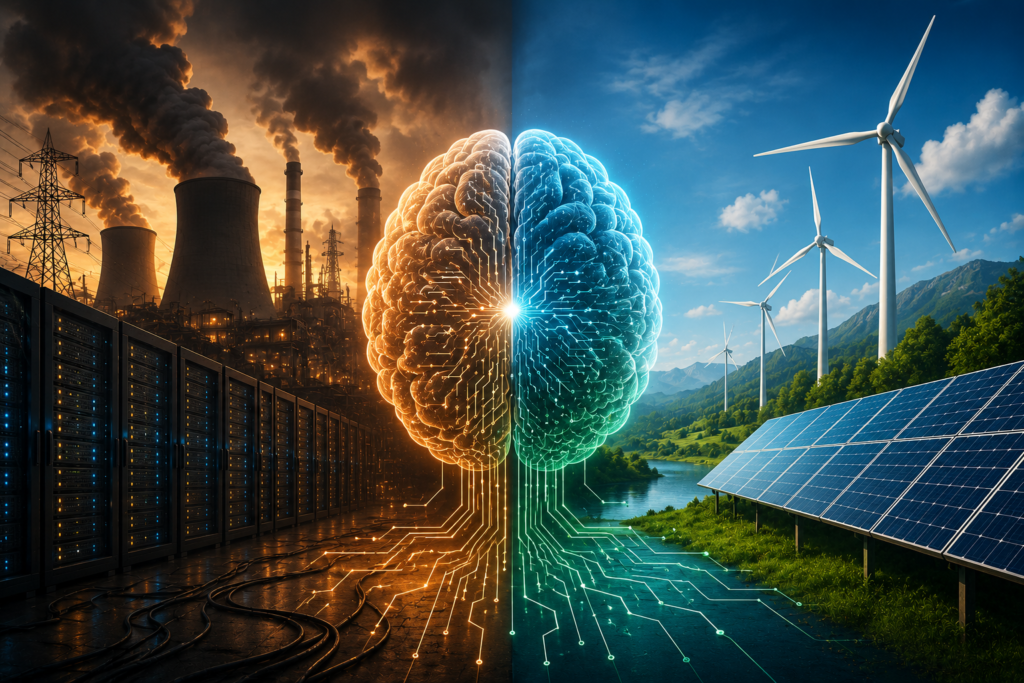
For most of the internet’s history, computing got cheaper and more efficient every year almost by default. Moore’s Law and better software meant that digital services scaled up while their environmental footprint scaled down, or at least stayed flat. Generative AI has broken that pattern. The industry’s dominant strategy — build bigger models, train them on more data, run them on more chips — has turned data centers from a background utility into one of the fastest-growing sources of electricity demand on Earth. The question now facing the industry, regulators, and the public is not whether AI uses a lot of energy. It clearly does. The question is whether what we’re getting back is proportionate to what we’re spending.
Global data center electricity consumption sat at roughly 415 TWh in 2024. The International Energy Agency’s Base Case has that figure nearly doubling to around 945 TWh by 2030, and other analysts — Gartner among them — put 2026 consumption alone at over 500 TWh, up sharply from the year before, with AI-optimized servers making up an increasing share of that load. In the United States, data centers are on a path from roughly 180 TWh today to somewhere between 400 and 600 TWh by decade’s end, depending on whose model you trust.
These aren’t just global aggregates floating somewhere out of sight. They’re showing up on local grids and local bills. Data centers already account for more than a fifth of Ireland’s national electricity demand. Virginia’s grid, home to the world’s densest cluster of data centers, has seen its capacity auction prices rise several-fold in a single market cycle, a cost that ultimately lands on ratepayers who never asked for a GPU cluster next door. Training a single frontier model can consume tens of gigawatt-hours — comparable to the annual electricity use of tens of thousands of households — before a single customer query has been answered.
The capital being thrown at this is staggering in its own right. The largest cloud and AI companies are collectively planning to spend several hundred billion dollars on AI infrastructure in 2026, an outlay that in some framings now rivals global investment in oil and gas production. That kind of capital doesn’t get allocated on a whim; it reflects genuine belief that scale is the path to better models. But it also means the industry has enormous financial and reputational incentive to keep telling that story, regardless of whether it’s still true.
It would be unfair to pretend the bigger-is-better strategy has produced nothing. Larger, more heavily trained models have delivered real jumps in capability: better reasoning, broader knowledge, more reliable code generation, translation quality that has quietly made professional translators reconsider their workflows. Some of the most useful AI applications — drug discovery acceleration, materials science for better batteries and solar cells, protein folding — required exactly the kind of scale that critics now question. AI systems are even being turned back on the energy problem itself: Google has reported cutting data center cooling energy by roughly 30% using AI-driven optimization, and grid operators are experimenting with AI for demand forecasting and load balancing.
Efficiency is also improving in ways that complicate any simple “AI is wasteful” narrative. Per-query energy costs for a given task have been falling, in some estimates by an order of magnitude annually, as new chip architectures and inference optimizations mature. Newer accelerator generations claim dramatically better performance per watt than their predecessors. If those efficiency curves continue, the argument goes, today’s energy anxiety will look as dated as 2010s worries about the internet’s electricity use — real at the time, but ultimately outpaced by better engineering.
Here’s the uncomfortable part: efficiency gains are being outrun by demand. Even as the energy cost per task falls, total consumption keeps climbing, because the number of users, the number of queries, and — increasingly — the complexity of “agentic” workloads that chain many AI calls together, are all growing faster than the hardware is getting more efficient. This is a textbook rebound effect, the same dynamic that’s undercut efficiency-based optimism in other energy-intensive industries for decades. Making something cheaper to run has a well-documented tendency to make people run a lot more of it.
There’s also a real question about what, exactly, all that additional scale is buying. The gap between successive generations of frontier models has, by many practitioners’ own admission, been narrowing even as the training runs get more expensive. A meaningful share of new capacity isn’t going toward pushing the frontier of what AI can do at all — it’s going toward serving more users, more often, sometimes for tasks that a far smaller and cheaper model could handle just as well. Summarizing an email, drafting a routine message, or answering a simple factual question does not obviously require the same infrastructure as scientific research applications, yet it’s often served by the same enormous models, because building and maintaining separate, appropriately-sized systems is operationally inconvenient.
And the environmental accounting is not as clean as hyperscaler sustainability reports suggest. Companies buy renewable energy certificates to offset operational electricity, but disclosed emissions are still rising because growth is outpacing clean-power procurement, not the other way around. The IEA itself estimates that a substantial share of the additional electricity demand from data centers through the end of the decade will still be met by gas and coal. Data centers run continuously, while solar and wind do not; matching consumption to clean generation on an hourly basis — the standard that actually matters for grid decarbonization — is a much higher bar than an annual offset, and almost no company has hit it at scale. Water use for cooling has grown just as fast, with large facilities consuming millions of cubic meters annually, often in water-stressed regions.
Perhaps the sharpest version of this critique isn’t about kilowatt-hours at all — it’s about distribution. The costs of AI’s energy appetite are diffuse and local: higher electricity prices for neighbors of data center clusters, strained water supplies, grid infrastructure paid for by ratepayers who may never use the AI products built on top of it. The benefits, by contrast, are concentrated: a handful of companies capturing enormous revenue and market value from products whose marginal usefulness, for a large fraction of queries, may not require the scale being built to serve them.
This asymmetry is what should give pause to any purely technological framing of the question. “Is AI’s energy use justified?” is not really answerable by comparing TWh to benchmark scores. It’s a question about whether the economic and environmental costs are being borne by the people who consent to them, and whether the industry’s push toward ever-larger models is a genuine technical necessity or, in part, a competitive arms race where no single company can afford to be the one that chooses restraint.
None of this requires concluding that AI’s energy use is straightforwardly bad, or that the industry should freeze in place. It does suggest a few things worth taking seriously. Right-sizing matters: not every task needs a frontier-scale model, and routing simple queries to smaller, cheaper systems is a real efficiency lever the industry has been slow to fully exploit. Transparency matters: hourly-matched clean energy claims, not annual offsets, should be the standard hyperscalers are held to, and independent verification should replace self-reported sustainability disclosures. And humility matters: an industry whose own leaders can’t yet say with confidence where the returns to scale will plateau should be cautious about treating “bigger” as a default answer rather than a hypothesis still being tested.
The energy bill for AI is real, growing, and increasingly visible on people’s utility statements and local grids. Whether it’s a bill worth paying depends less on the next benchmark score than on questions the industry has so far been reluctant to answer in public: who decides how big is big enough, and who gets to say no.
web Admin
Figures cited are drawn from IEA “Energy and AI” analysis, Gartner data center forecasts, and industry sustainability disclosures current as of mid-2026; given the pace of change in this sector, readers should treat all projections as estimates subject to revision.




Leave a Reply
You must be logged in to post a comment.